Pocket cipher device
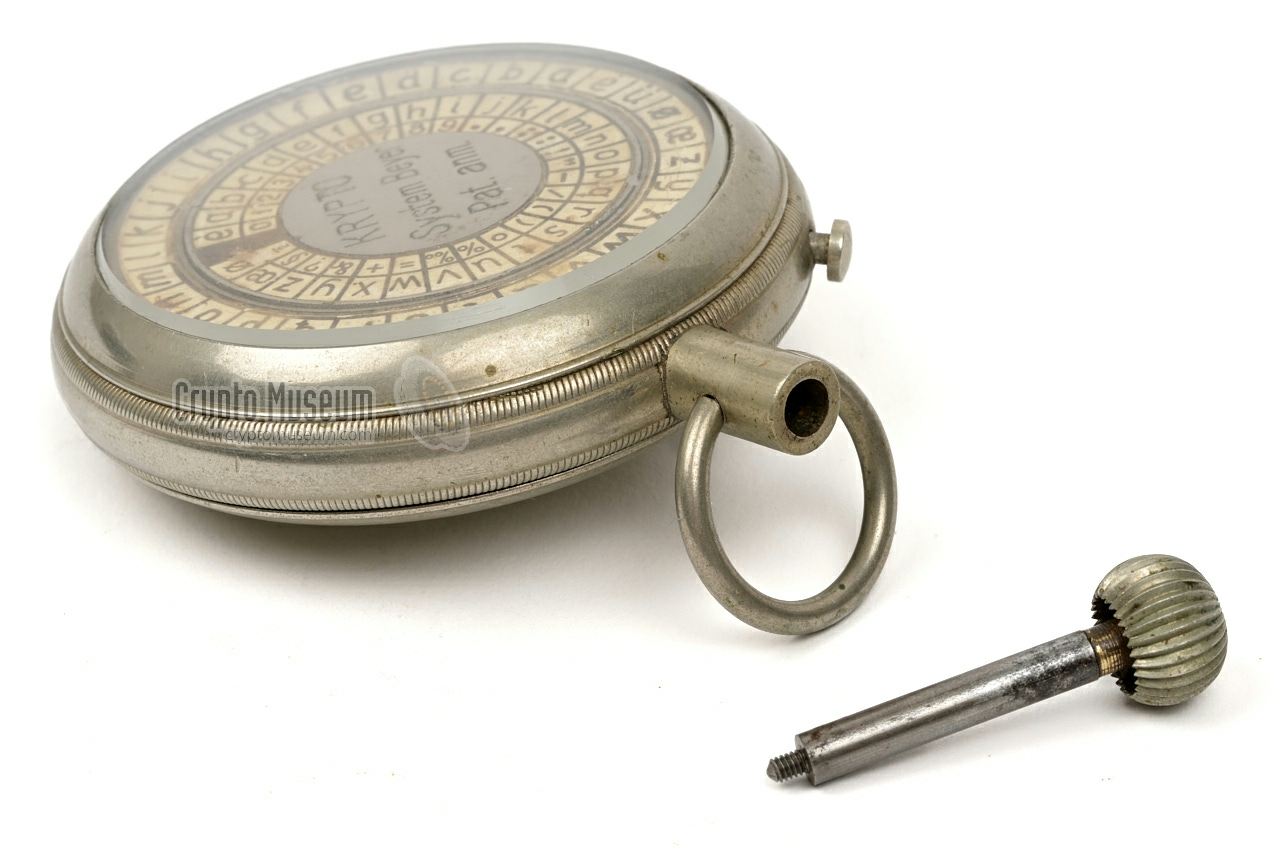
Krypto System Beyer, also known as Beyer or Krypto, is a pocket
cipher machine in the shape of a pocket watch, developed around 1933
by Danish inventor Peter Georg Grove Beyer
(1881-1961) in Copenhagen (Denmark).
It was manufactured and sold by A/S The Danish Cipher Machine Co. Ltd.,
also in Copenhagen [4]. It is similar, both in appearance and function,
to the Kryha Liliput.
|
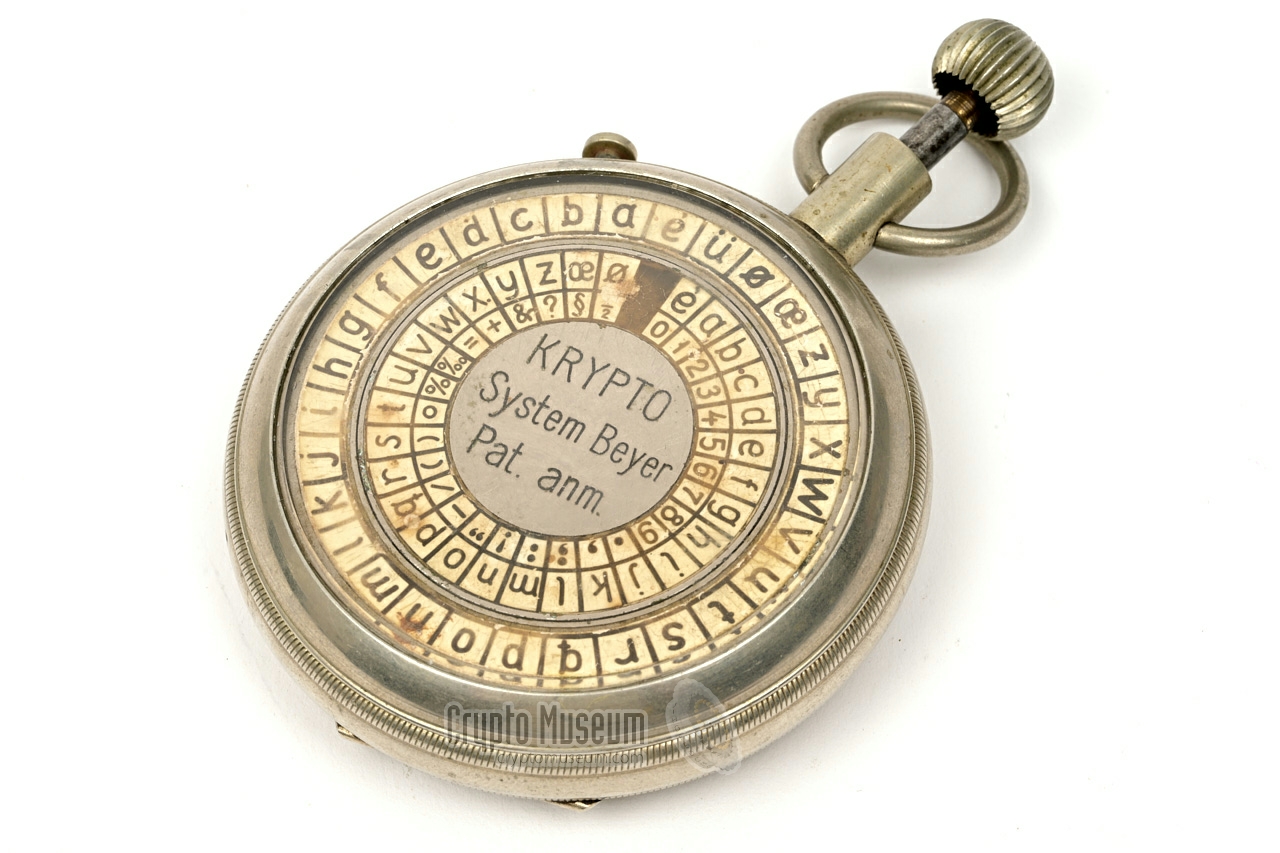
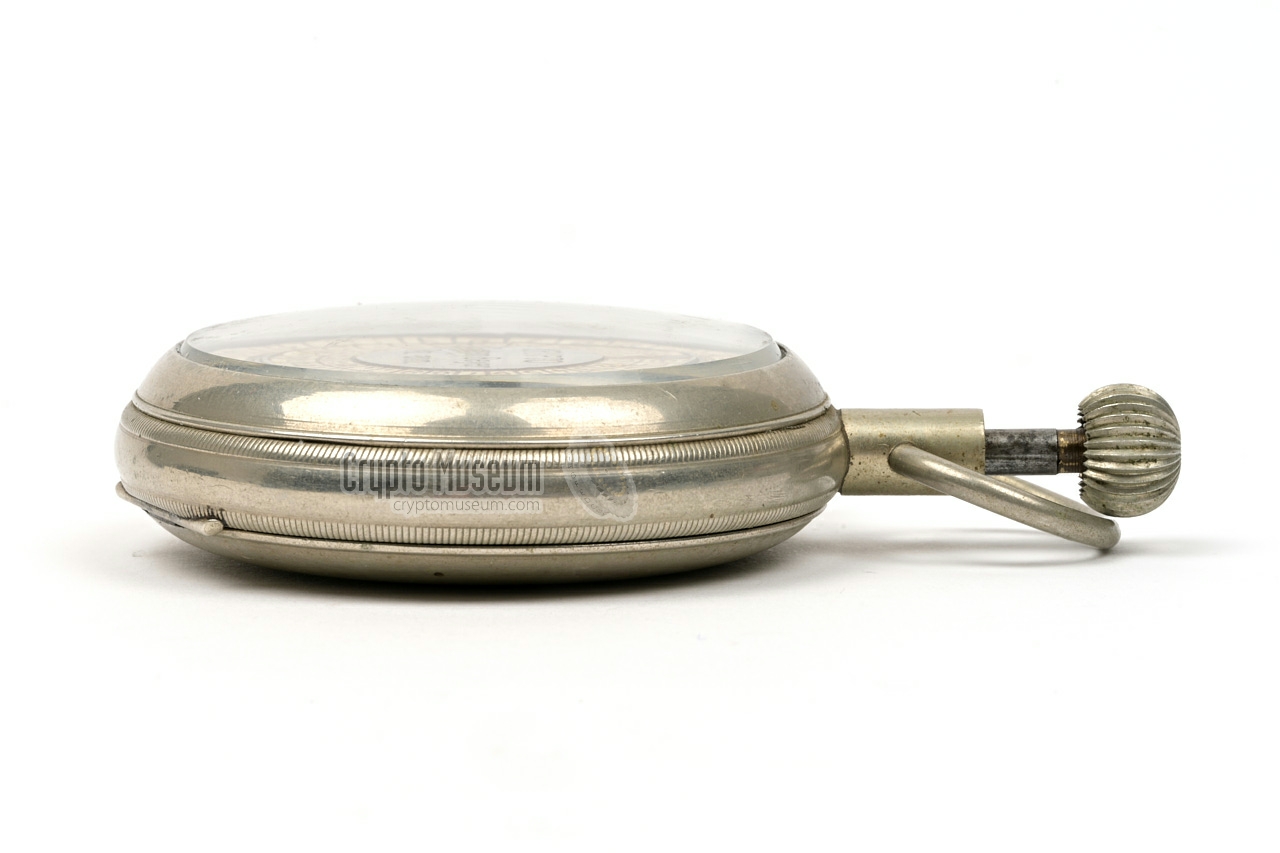
The device is housed in a polished nickel-plated enclosure that resembles
the pocket watches of the era. It has a diameter of 62 mm and weighs 170 grams.
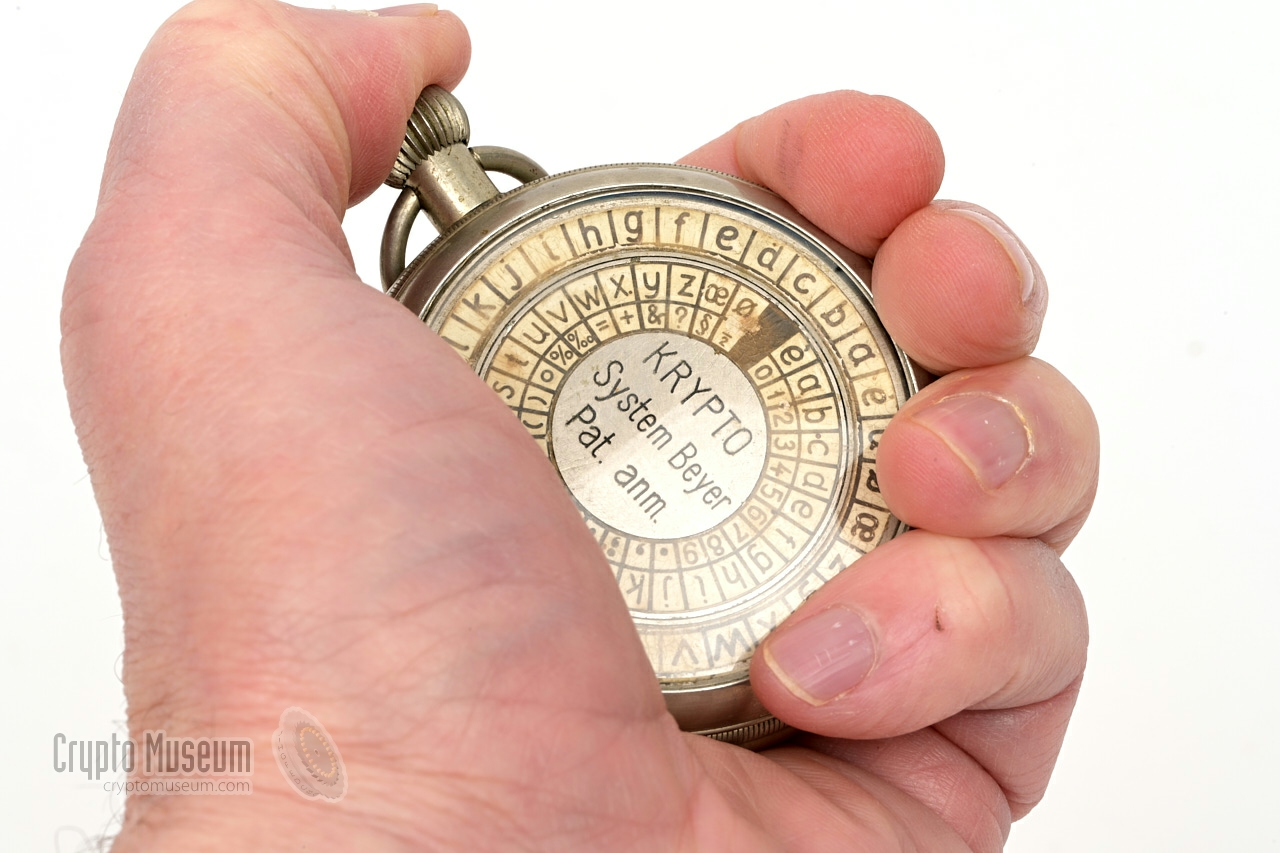
Instead of a dial with hands however, there are two concentric discs
with alphabets, numbers (0-9) and various punctuation marks.
The outer disc is the reverse of the inner disc.
The device is operated by pushing down the crown 1 at the top, which is
actually a spring-loaded plunger. After each character, the crown is
pushed, which moves both alphabet discs an arbitrary number of steps in
clockwise direction.
|
|
|
The device is based on the theoretical calculations of the Danish engineer
A. Køhl, who had also been responsible for the development of the codes
used by the Danish Foreign Office, and for improving the secret codes of the
British Admiralty in London (UK) during World War I
(WWI). Køhl's ideas
were put into practical use by
Peter Georg Grove Beyer – an official of
the Danish State Railways – in conjunction with Captain A.P. Botved and
the Danish Army Technical Corps.
Botved, who had been a Tokio pilot, was also the person behind
A/S The Danish Cipher Machine Co. Ltd. in Copenhagen (Denmark), which
obtained the manufacturing and marketing rights to the product.
Apart from the pocket watch sized device, the company also made a larger
one which was used in combination with 2 electric typewriters. The two
models were compatible, but the larger one was never in popular demand.
The small one is very similar – both in appearance and in function – to the
Kryha Liliput,
developed in 1926 by Alexander von Kryha in Germany.
Historians believe that the Beyer Pocket watch Cipher Device was only
made in small quantities.
➤ More about Peter Georg Grove Beyer
|
 |
-
On a pocket watch of the era, the crown is normally used for winding up
the device and for adjusting the time. In this case it is used as a
push-down button, to advance the cipher to the next state.
|
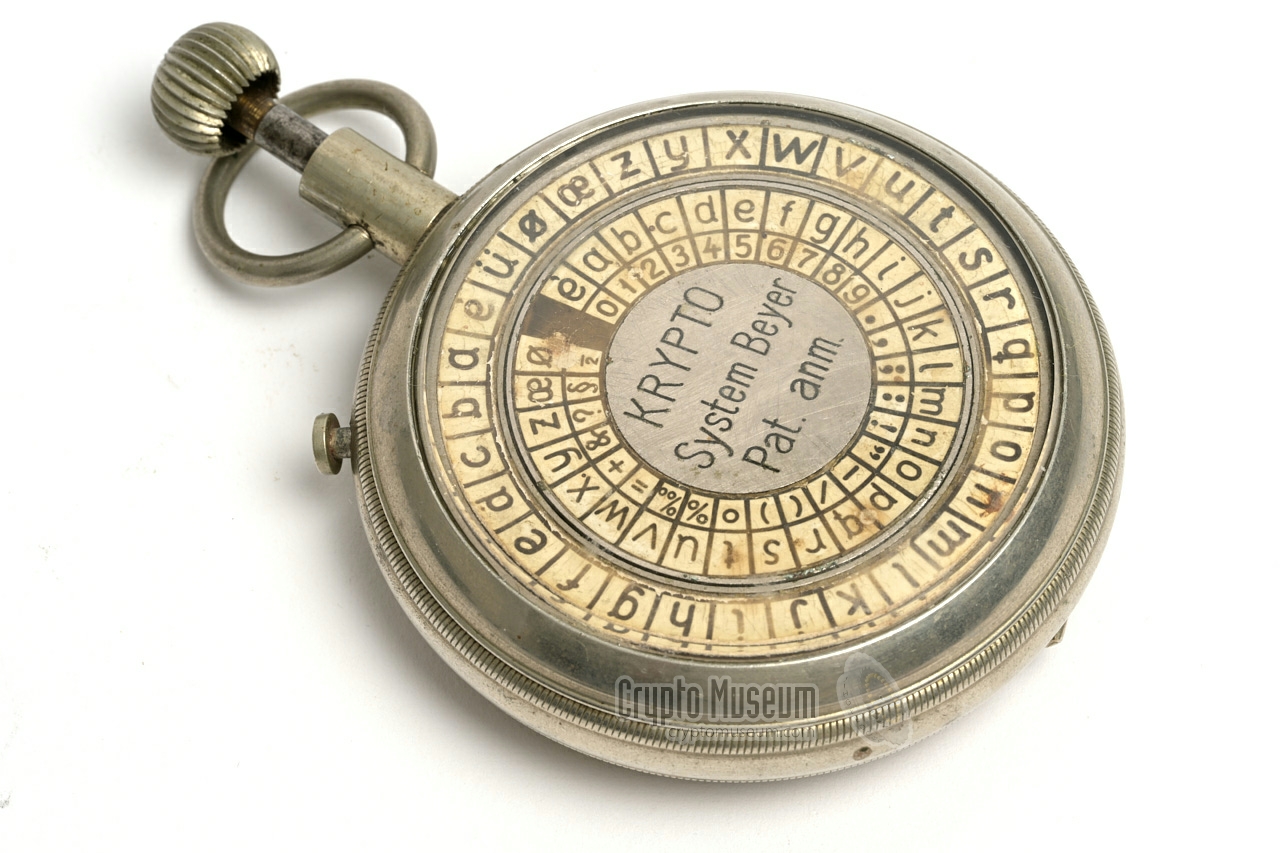
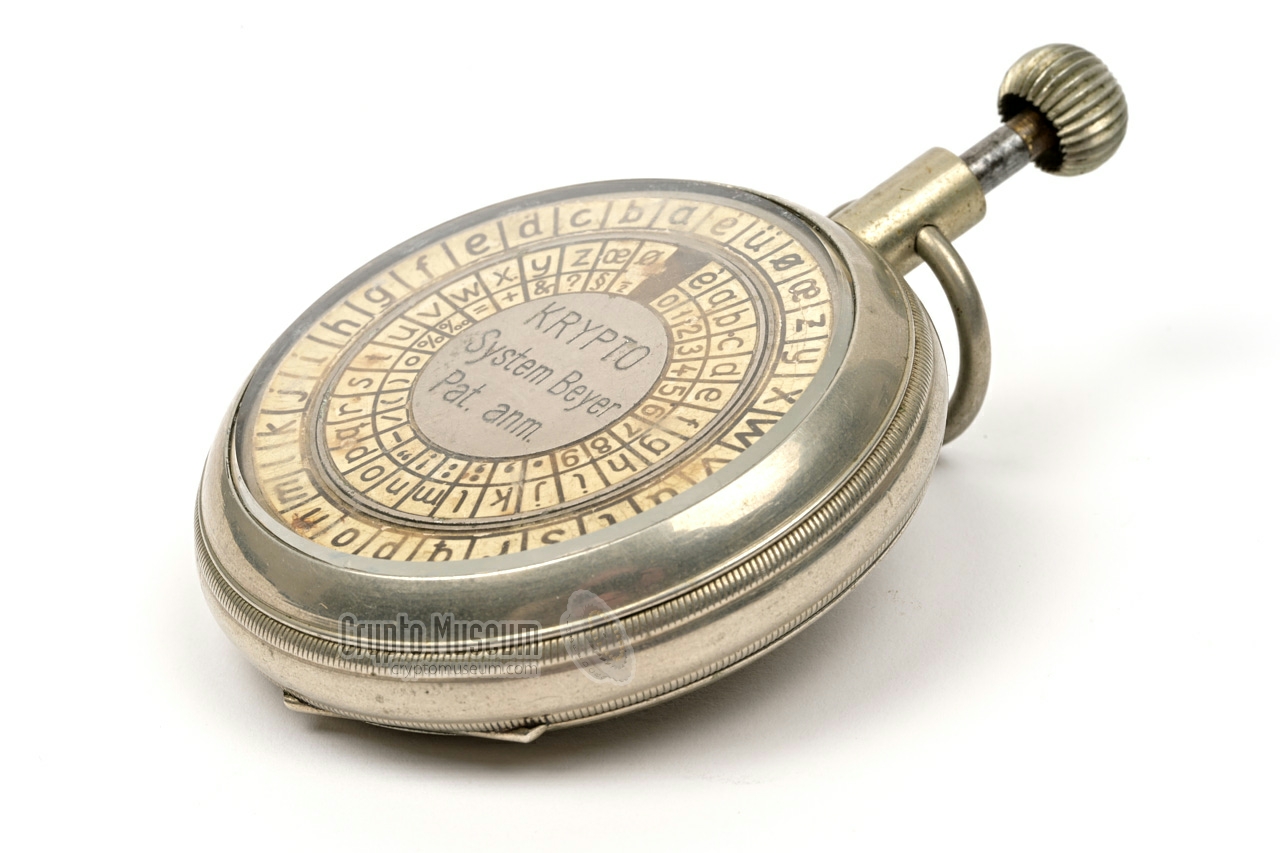
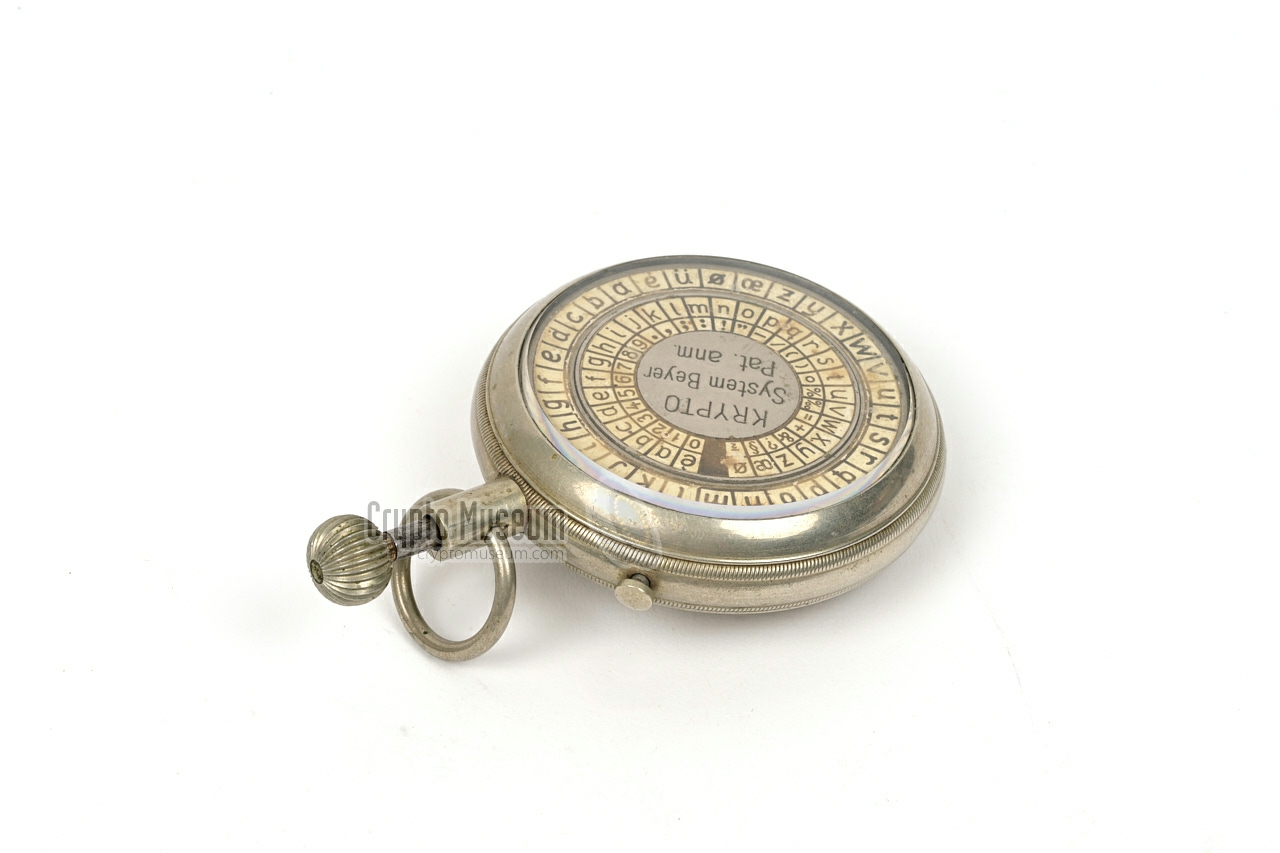
The images below show the features of Beyer's Krypto System.
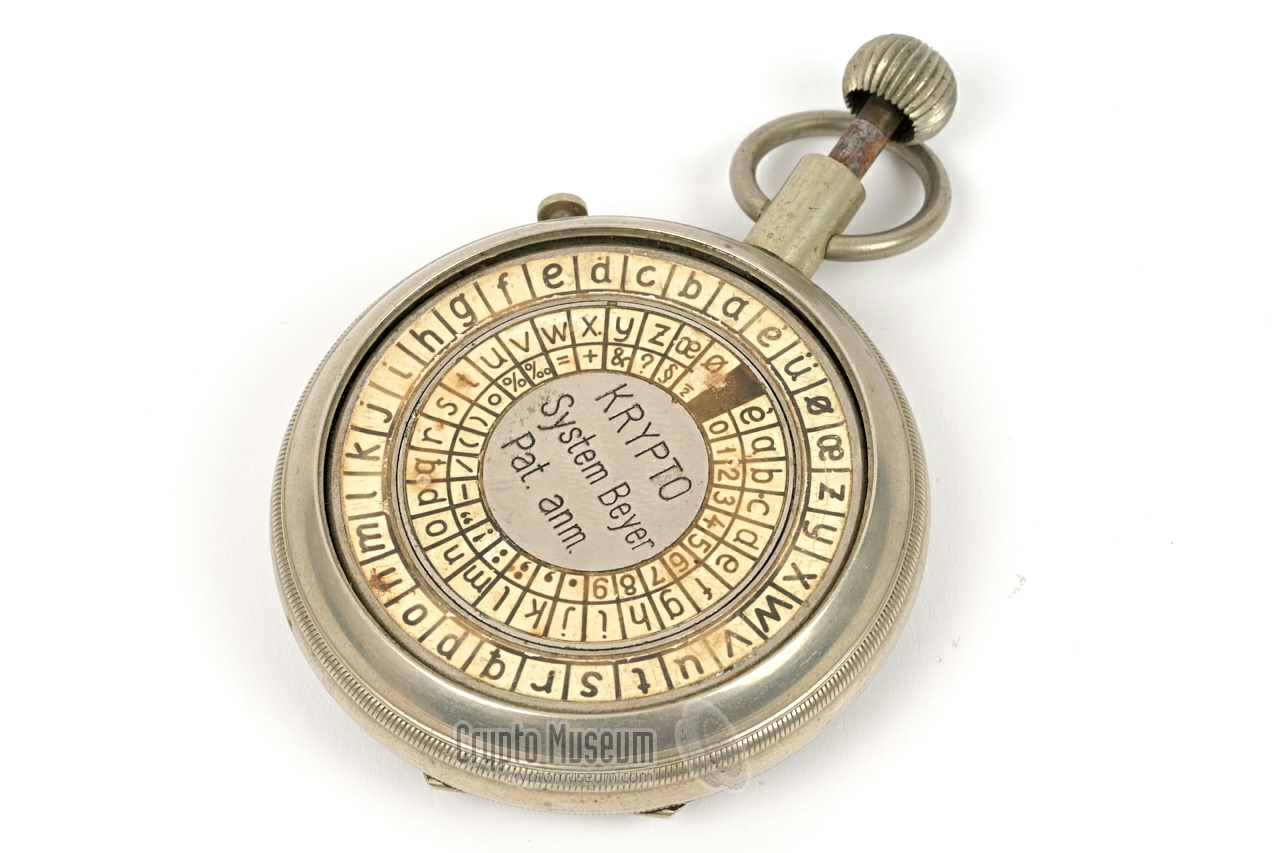
The device looks like a pocket watch of the era, but instead of a regular
dial it has two concentric letter discs, covered by a concave-shaped glass
panel. The inner disc contains letters, numbers and punctuation marks,
printed in clockwise direction. It is used for the plaintext.
The outer disc contains only letters, printed in counter-clockwise direction.
It is used for the ciphertext. As a result, Krypto System Beyer can be regarded
as mechanised polyalphabetic cipher, based on the reverse caesar cipher.
After the encryption of each letter, the crown has to be pushed inwards to advance
the stepping mechanism. This causes both discs to make an arbitrary number of steps
in clockwise direction, subject to the current setting of the key. The
key setting procedure is described below.
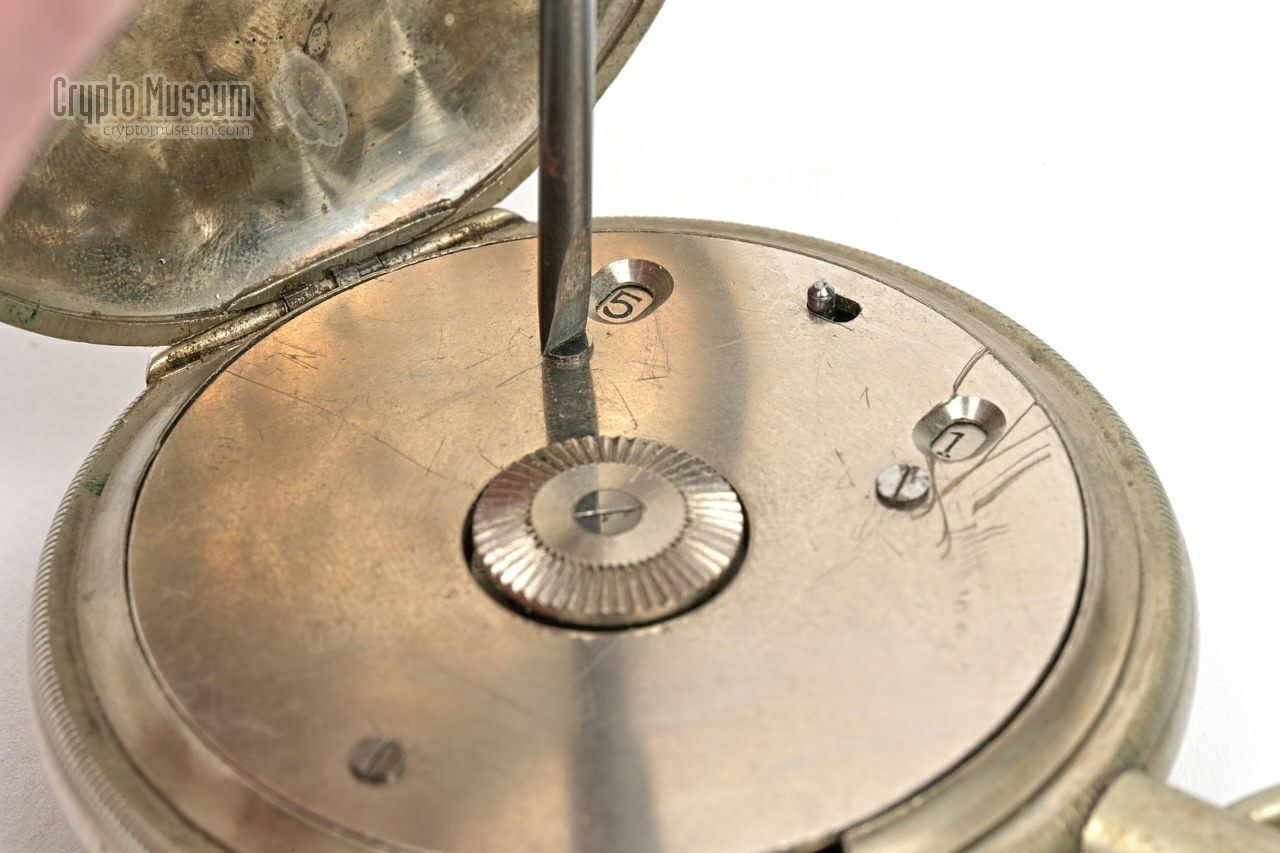
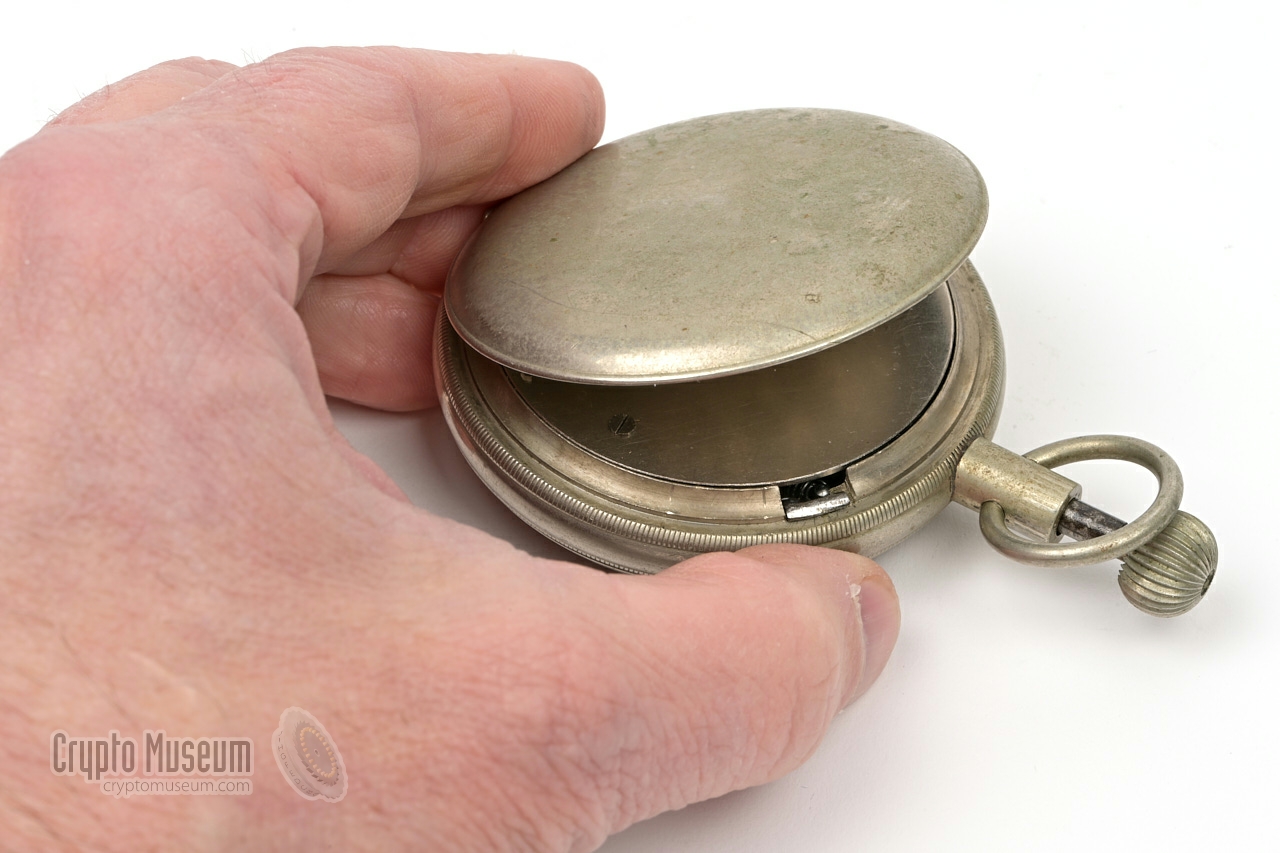
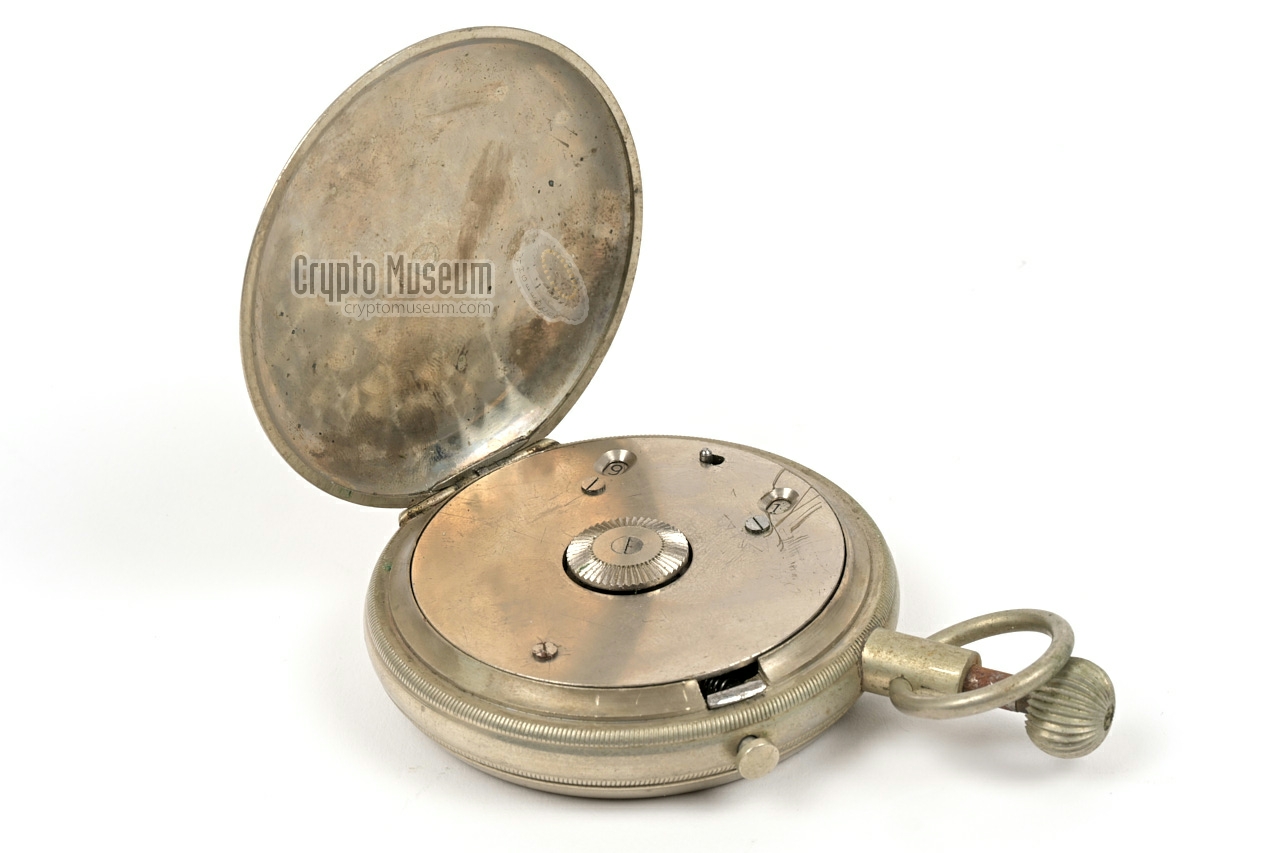
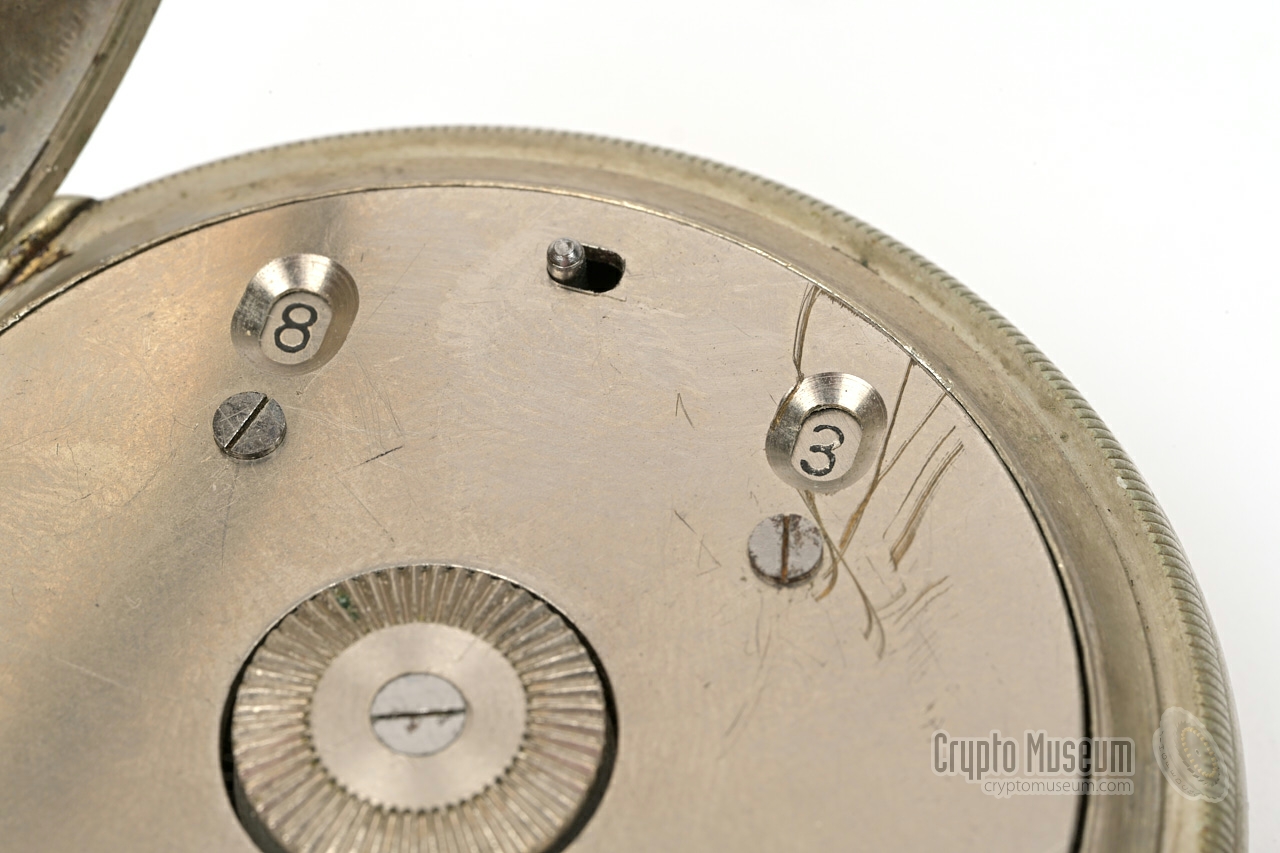
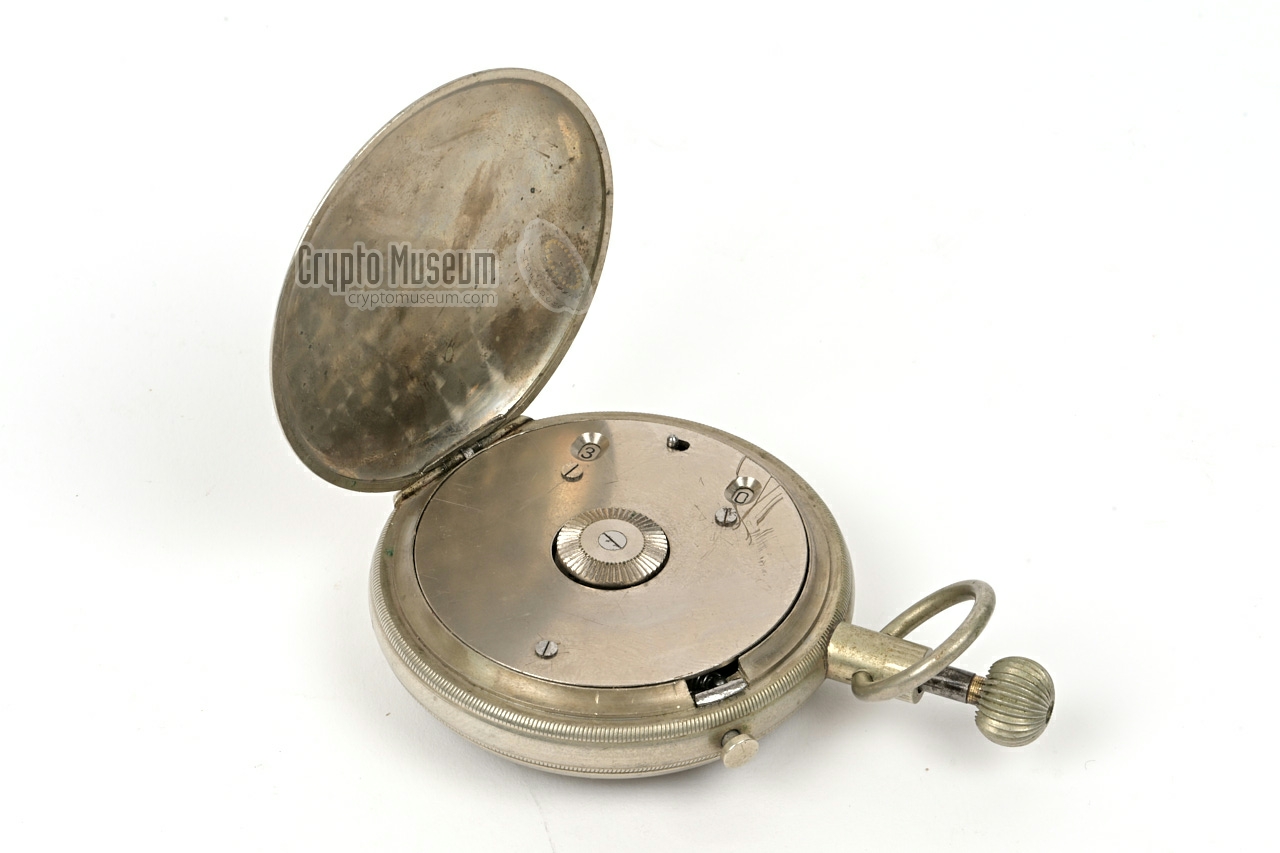
The image below shows the rear side of the device, which has to be
accessed in order to alter the key setting. Press the small knob aside
the crown to open the rear lid. This reveals two windows through which a
number is visible, a small key setting selector and a large knurled knob.
|
|
The cryptographic key consists of:
|
- 2 Chosen numbers (1-9) and (0-9) at the back
- 2 Chosen letters at the front
|
|
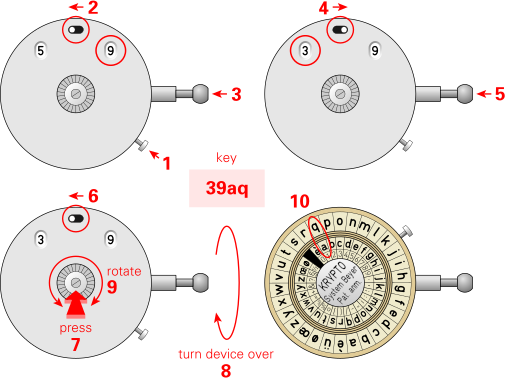
In the following example, we assume the key is 39aq .
Now do the following:
|
- Open the lid at the rear (by pressing the small button at the circumference).
- Ensure the key setting selector is in the leftmost position.
- Press the crown repeatedly until the number '9' appears in the rightmost window.
- Put the key setting selector in the rightmost position.
- Press the crown repeatedly until the number '3' appears in the leftmost window.
- Put the key setting selector back to the leftmost position.
- Push the knurled disc at the center inwards and keep it in this position.
- Turn the device around whilst keeping the knurled disc depressed.
- Rotate the knurled disc until the letter 'a' on the inner disc...
- ...is opposite the letter 'q' on the outer disc.
|
The key is now set and the device is ready for its first encipherment.
The plaintext letter on the inner disc is replaced by the letter opposite
it on the outer disc. Each time a letter is encrypted, the crown is pushed
once, so that the inner and outer discs are moved to new positions.
The black square '◼' should be used to shift from letters to numbers
and vice versa. We will now use the above key to encrypt the sentence:
delivery tomorrow at 03:45 local time.
The first letter 'd' on the inner disc is opposite the 'n' on the other disc.
Now press the crown once to move to the next position. The second letter 'e'
on the inner ring is now opposite the 'm' on the outer ring. Repeat this for
all letters in the message. With black squares inserted to shift to and from
numbers, and spaces inserted to form 5-letter groups, the encrypted message
is:
deliv eryto morro wat◼0 3:45◼ local time
nmegw müwüb eëøzë woørq lbjin campb xcag
Decryption works the other way around: set the key (39aq) as described above.
Translate the first ciphertext letter on the outer disc to the plaintext letter
below it on the inner disc. Then press the crown to advance the inner and outer
discs to their new positions. Repeat this for all letters.
➤ Original operating instructions
|
|
The following versions and variants of the Beyer Krypto System are
currently known:
|
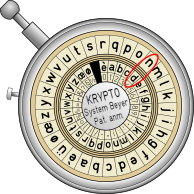
- Beyer Krypto 26 1
This seems to be a rare 26-character version of the 30-character version
show above. It has two concentric discs with 26 characters each.
The characters are arranged as follows, in the order of the
Latin alphabet [3]. We don't know if there were language variants.
z y x w v u t s r q p o n m l k j i h g f e d c b a
a b c d e f g h i j k l m n o p q r s t u v w x y z
1   2   3   4   5   6   7   8   9   .   ,   ◼   0
- Beyer Krypto 30 1
This appears to be the most popular version of the pocket watch type.
It has two concentric discs with 30 characters each. The version featured
here, is of this type, as are most of the ones in other collections.
By default, the characters are arranged as follows:
è ü ø æ z y x w v u t s r q p o n m l k j i h g f e d c b a
a b c d e f g h i j k l m n o p q r s t u v w x y z æ ø ◼ è
1 2 3 4 5 6 7 8 9 . , ; : ! " - / ( ) o % ‰ = + & ? § ½ ◼ 0
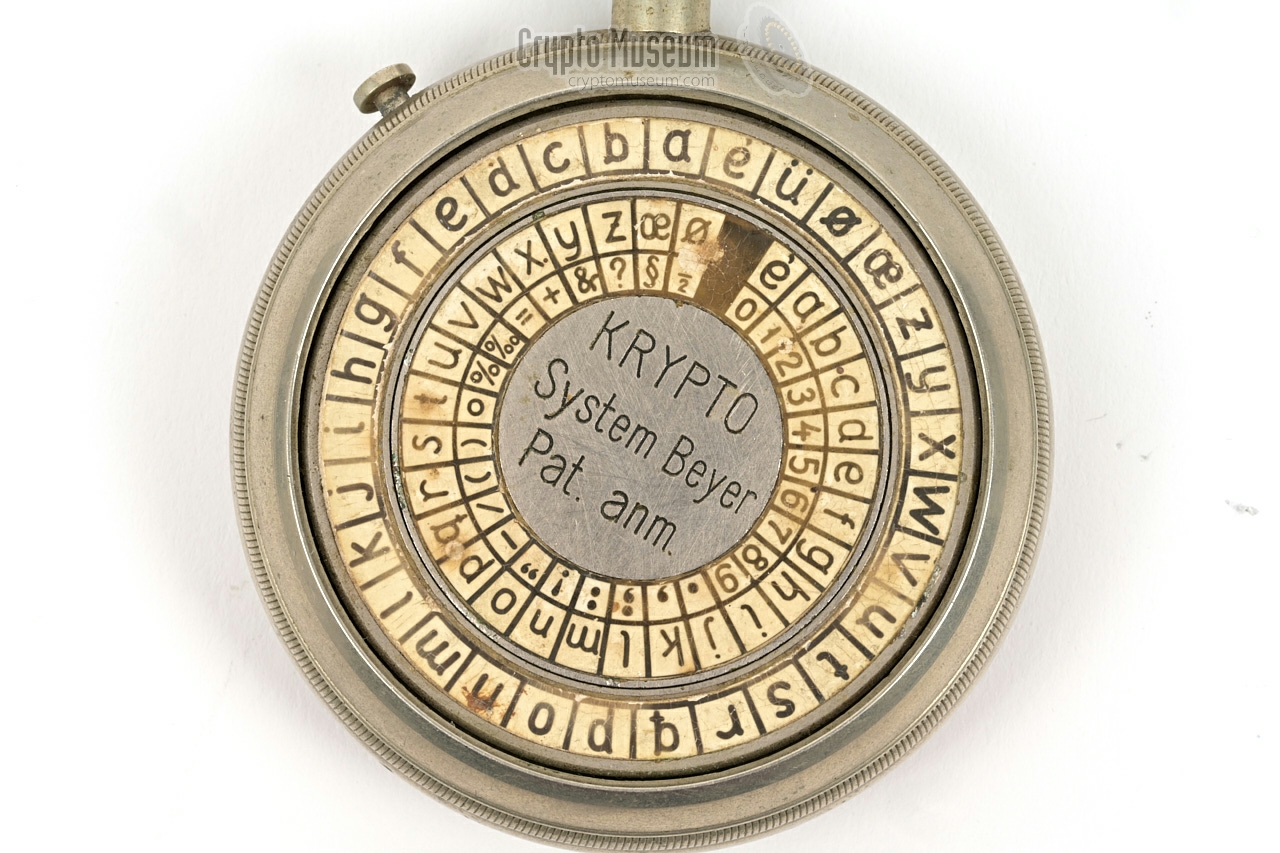
Apparently there were various language variants of this version,
such as this one
that was auctioned at Bonhams in 2022 [7].
The characters are arranged as follows:
è z y x w v u t s r q p o ñ n m L l k j i h g f e d C c b a
a b c C d e f g h i j k l L m n ñ o p q r s t u v ◼ x y z è
1   2   3   4   5   6   7   8   9   .   ,   ;     ◼     0
In the above table, the capital letters represent ligatures that are not
available in HTML:
C → ch
L → ll
- Beyer Magnus Krypto
Earlier large electromechanical version of the Beyer Krypto System with
two electric typewriters. It is compatible with the pocket device and is further
described below.
|
|
-
The names 'Beyer Krypto 26' and 'Beyer Krypto 30' are not the official
designators, but are used by us to discriminate between the two basic
versions, with either 26 or 30 positions on the letter discs.
|
Magnus Krypto is the electromechanical version of the Beyer Krypto System.
It consists of two modified electric typewriters with the
cipher unit connected in between. One typewriter is used for entering
the cleartext, whilst the ciphertext is automatically printed on the
other one.
The image above shows was this rather large setup looked like. The cipher unit
is at the centre. It is connected to both typewriters via thick multicables.
Behind it is a power supply unit (PSU) that is connected – via a
switch –to the mains. It is compatible with the pocket watch version and was
intended for office use. It was developed in 1919, more than 10 years
before the watch-version.
|
A Danish invention has just been perfected which seems likely to become an export
article with enormous possibilities. The invention consists of a mechanical device
to do away with the codebooks which hitherto have been necessary to all who
telegraph in a language which only the initiated can read. Code books have this
defect that if one book in a private system is lost, an entirely new one has to be
compiled which means a great loss of time and money.
The new Danish system "Krypto" does not have that drawback. The machine may may
fall into other hands, even those of the finest experts, but there would not he
the slightest possibility of their decoding the cipher unless they also possess
the key, which consists of two chosen numbers and two chosen letters.
The company owning the manufacturing and selling rights
is A/S The Danish Cipher Machine Co. Ltd., of Copenhagen.
Their leader is the well -known Danish Tokio pilot Captain A.P. Botved.
The system is based upon the theoretical calculations of the late A. Køhle,
a Danish engineer.
He was quite a genius on this domain and had for instance, compiled the codes
used in the Danish Foreign Office and also in other countries.
During WWI he was called over to London to assist the British Admiralty
in altering its secret codes. One of the officials of the Danish State Railways,
P.G.G Beyer succeeded in putting Køhle's theories into practical use.
In conjunction with Captain Botved and the Danish Army Technical Corps,
the mechanical part of the problem was then solved.
The company is now making two types of cipher machines: a small one about
the size of a pocket watch and a larger one working in combination with two
teletypewriters. The two types can correspond with one another so that the
cipher arranged by means of the small machine can be decoded by the larger
unit and vice versa. The system of the larger machine is particularly ingenious.
When a telegram is written on one machine , it comes out in code on the other;
thus if the cipher message is copied on the one machine, the other writes it
in plain language. The certainty of the system is considered to be perfect
and the coding systems may be altered indefinitely.
|
Apparently, Beyer
had great confidence in his inventions, as he registered
patents for both devices — the big typewriter and the pocket watch one —
in various countries, including Denmark, the UK, the US, Germany
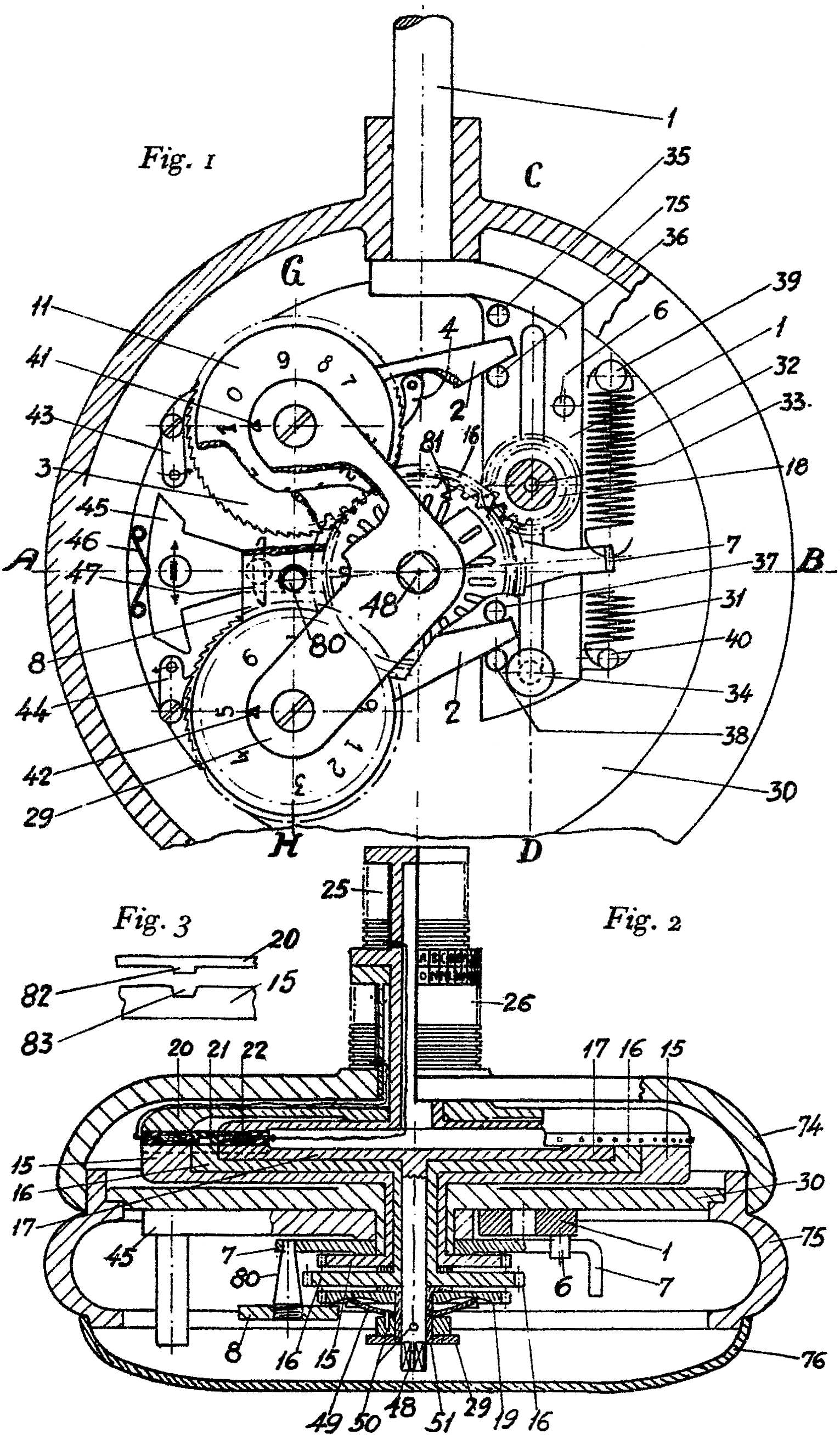
and Switzerland. Below are all Beyer's
patents that we've found so far:
|
 |
|
Patents related to typewriter-style device
|
|
|
|
|
Patents related to watch-style device
|
|
|
- DK 47,656, Kryptograf
Peter Georg Grove Beyer. 24 January 1931.
- UK 383,802, Improvements relating to Cryptographic Apparatus
Peter Georg Grove Beyer. 22 January 1932.
- CH 167,193, Einrichtung zum Aufsetzen und Entziffern von Geheimschrift
Peter Georg Grove Beyer. 23 January 1932.
- FR 730,433, Appareil cryptographique
Peter Georg Grove Beyer. 23 January 1932.
- DE 601,153, Vorrichtung zum Chiffrieren
Peter Georg Grove Beyer. Filed 24 January 1932.
- US 1,949,140, Cryptographic Apparatus
Peter Georg Grove Beyer. Filed 25 January 1932.
|
|
According to Beyer, the system offered absolute secrecy, which means
that under normal circumstances, the system could not realistically
be broken by an adversary. If this was true, Beyer certainly had
success coming his way. In the
above quoted article
[5] it is claimed that:
|
The certainty of the system is considered to be perfect
and the coding systems may be altered indefinitely.
|
Further down the article it is claimed:
|
Thus the possibility of solving cryptograms written by means of 'Krypto'
is extremely small; as may be seen from the following figures: the letters
on the paper dials may be set in 30!2 (i.e. 7034 × 1061) different
combinations, the cam-wheels (in the present type with nine or ten spacings)
may be combined in 62478 × 176990 different settings, in order to arrive at
the commencing position for a certain period of letters 80910 combinations
would have to be tried before finding the right one.
If the above information is correct, the total number of combinations would be:
30!2 × 62478 × 176990 = 7.78 1074
Which is equivalent to ~ 249 bits. This is a fenominal number, even by
today's standards. But how realistic are these figures? Lets consider the
largest contributor: the dials (i.e. letter rings). According to the
article,
the number of combinations on the letter rings is 7.034 × 1064.
This would indeed be the correct if the letters could be reordered in the field,
which is clearly not the case. The paper discs are glued to the mechanism
and it is doubful whether any users ever swapped their letter rings. This would
require the glass at the front to be removed.
All surviving Beyer devices have been found with their original rings
still in place, so this is not realistic.
The second largest contributor are the cam-wheels, which were fixed inside
the machine and could not be modified by the user. Although
there may be 62478 × 176990 = 11,057,981,220 possibilities,
the cam-wheels remained in place for the entire life cycle of the device.
According to Kerckhoffs' Principle [8], we have to assume that the
device may fall into adversary's hands, which means that the entire
system is known by the adversary, and that the only thing that keeps
the message secret is the key. The question is now, is the key long enough
to satisfy Kerckhoffs?
According to the article, the cipher
period is 80910, which is equivalent to ~ 16 bits. Although this may
have seemed like large number in 1932, it is low enough to dismiss it as
a weak cipher. In reality, the value might even be lower, as the total
number of possible key settings is lower. The number windows have 9 and
10 possible start positions respectively, whilst the knurled disc at the centre
has 29 possible offsets (we can't use the black square).
This give us a total of:
9 × 10 × 29 = 2610 possible settings
This number is low enough, even in 1932, to be checked manually.
The cipher period is calculated by multiplying the number of spacings
of the cam-wheels (9 × 10 = 90), and multiplying that with the
number of combinations on the letter discs (30 × 30 = 900). As
the ◼ on the inner disc cannot be used, we have to subtract
1 setting. The period is therefore calculated as follows:
9 × 10 × (30 × 30 - 1) = 80910
However, since the number of possible key settings
is (much) lower, namely 2610, there would be no need to check the
entire period. This can be regarded as a weakness of the cipher.
|
Note that the above calculations are for the Krypto Beyer System
with 30 letters on the disc. For devices with 26 positions, the number
of different settings is 2250, and the period is 60750.
Another weakness is that the number of steps (of the inner and outer
letter rings) is always between 1 and 5. Furthermore, since both
rings step in the same direction (clockwise), the distance between
two successive alphabets is 4 at most, and in some cases even 0.
This means that there is a (fair) chance that two successive letters
are encrypted with the same transposed alphabet.
The table below shows the number of steps (spacings) for each position
of the two cam-wheels. The leftmost cam-wheel controls the stepping
of the inner letter ring, whilst the rightmost one controls
the outer letter ring. Note that the left cam-wheel has 9 positions,
whereas the right one has 10 positions. As the number of positions
do not share a common factor — they are known as coprimes or
relatively primes — the maximum cycle length (period) is
guaranteed [10].
|
| | | Position |
| Cam-wheel | letter disc | 1 | 2 | 3 | 4 | 5 | 6 | 7 | 8 | 9 | 0 |
| Left | Inner | 2 | 4 | 2 | 5 | 3 | 4 | 2 | 4 | 3 | |
| Right | Outer | 2 | 3 | 5 | 3 | 1 | 3 | 2 | 3 | 2 | 4 |
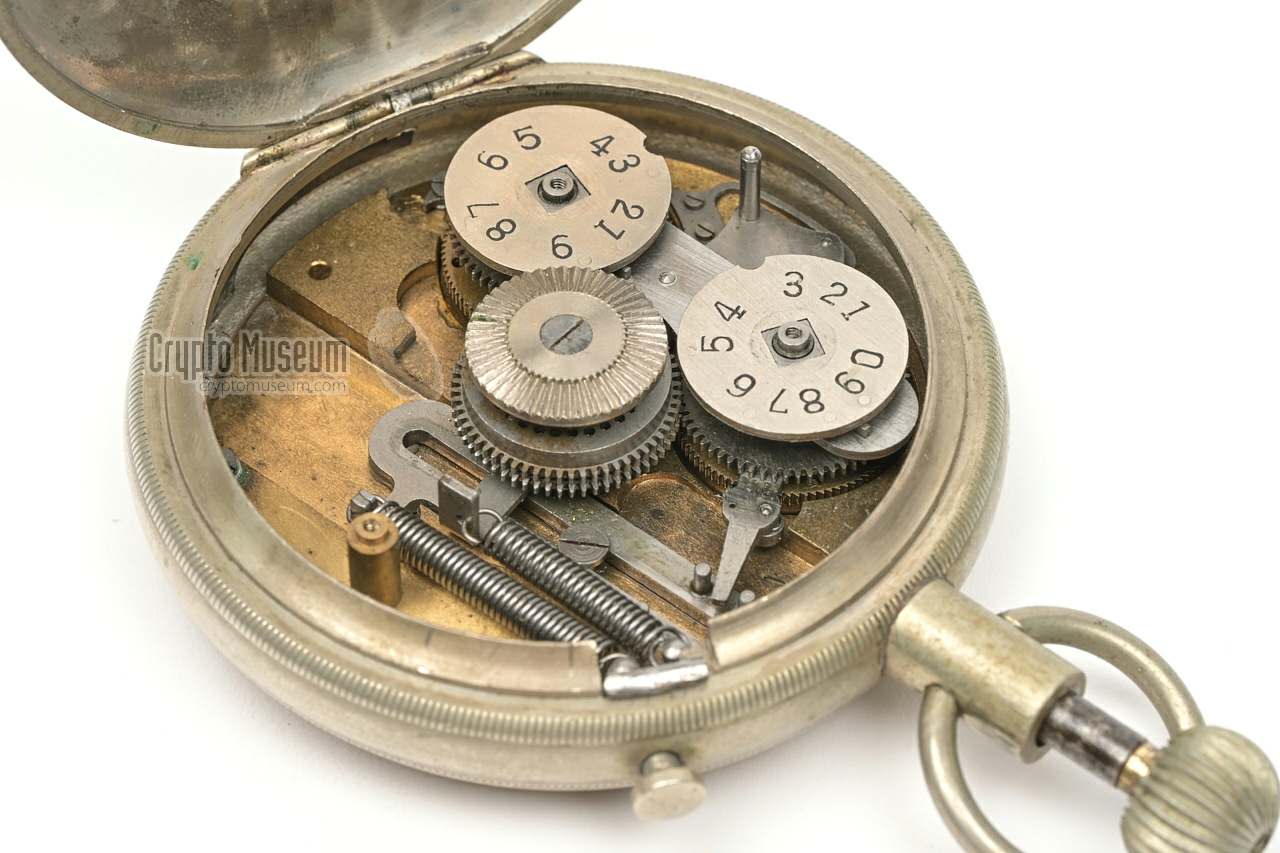
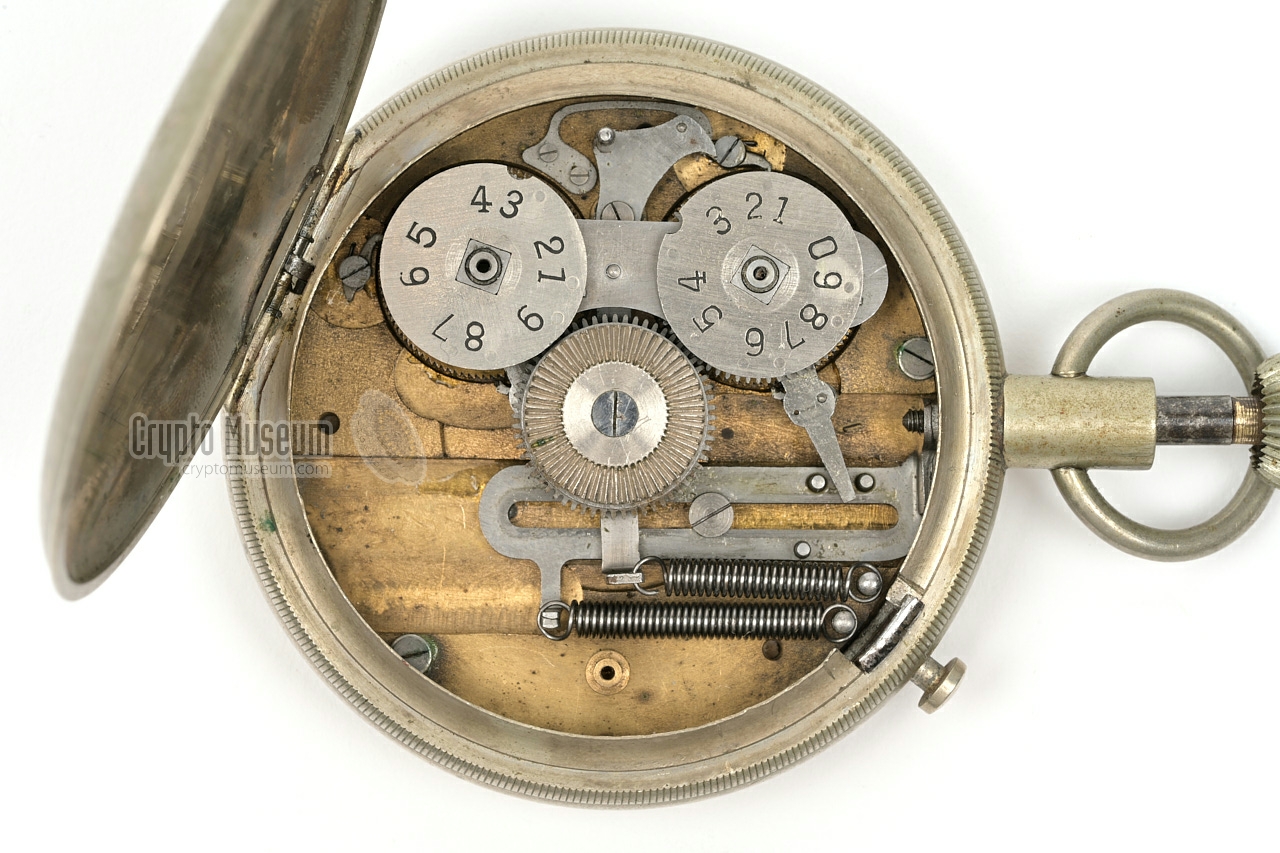
|
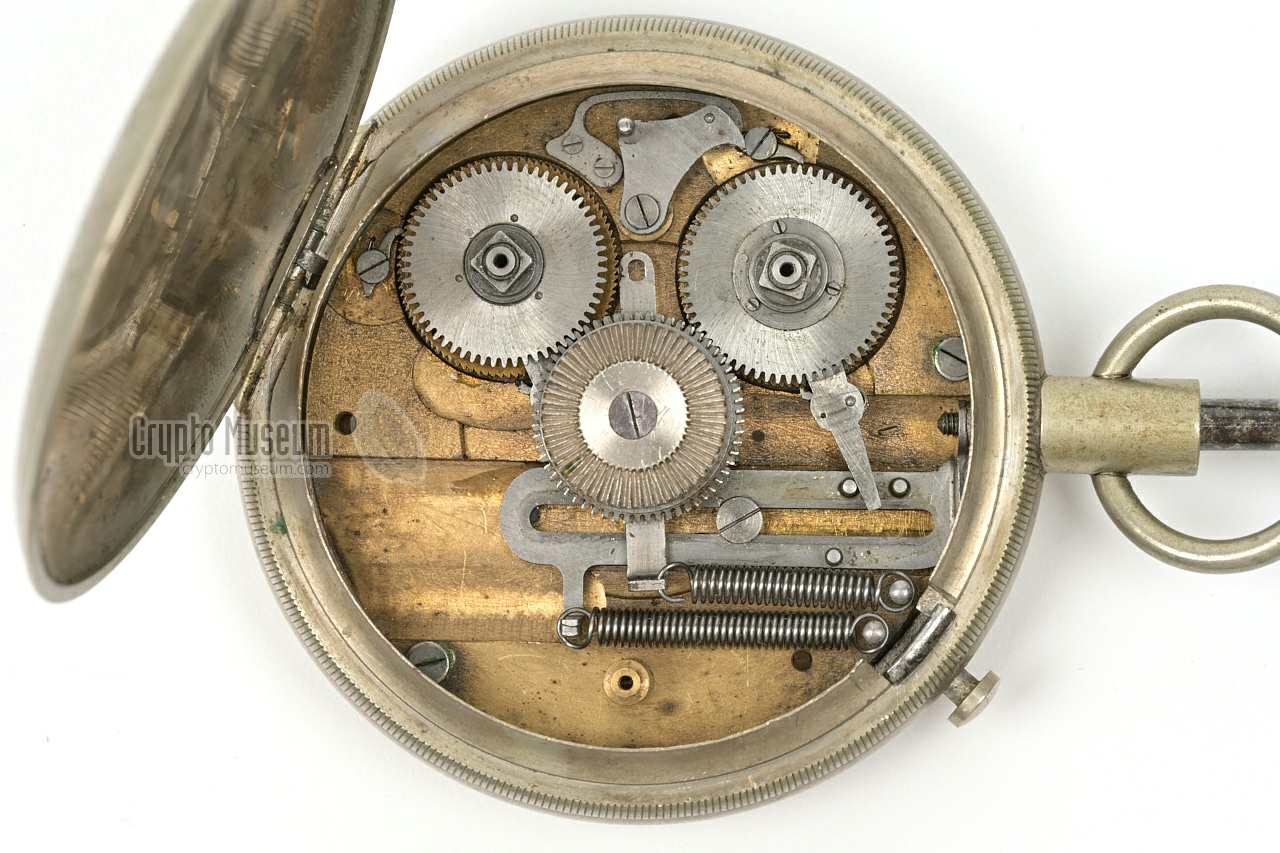
Be careful when opening the device, as the two cam-wheels
(on top of the stepping mechanisms) are held in place by the rear
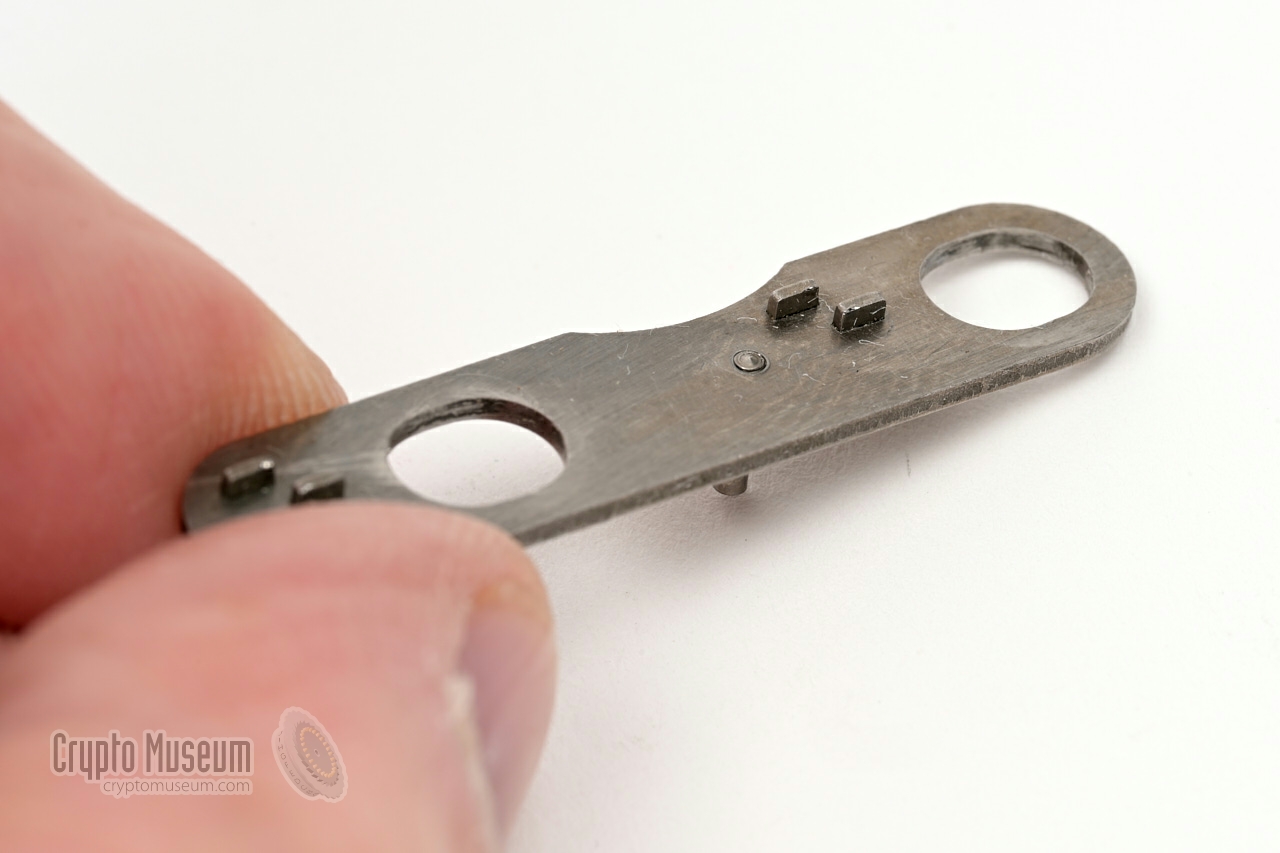
panel and may therefore fall out. Immediately below the numbered
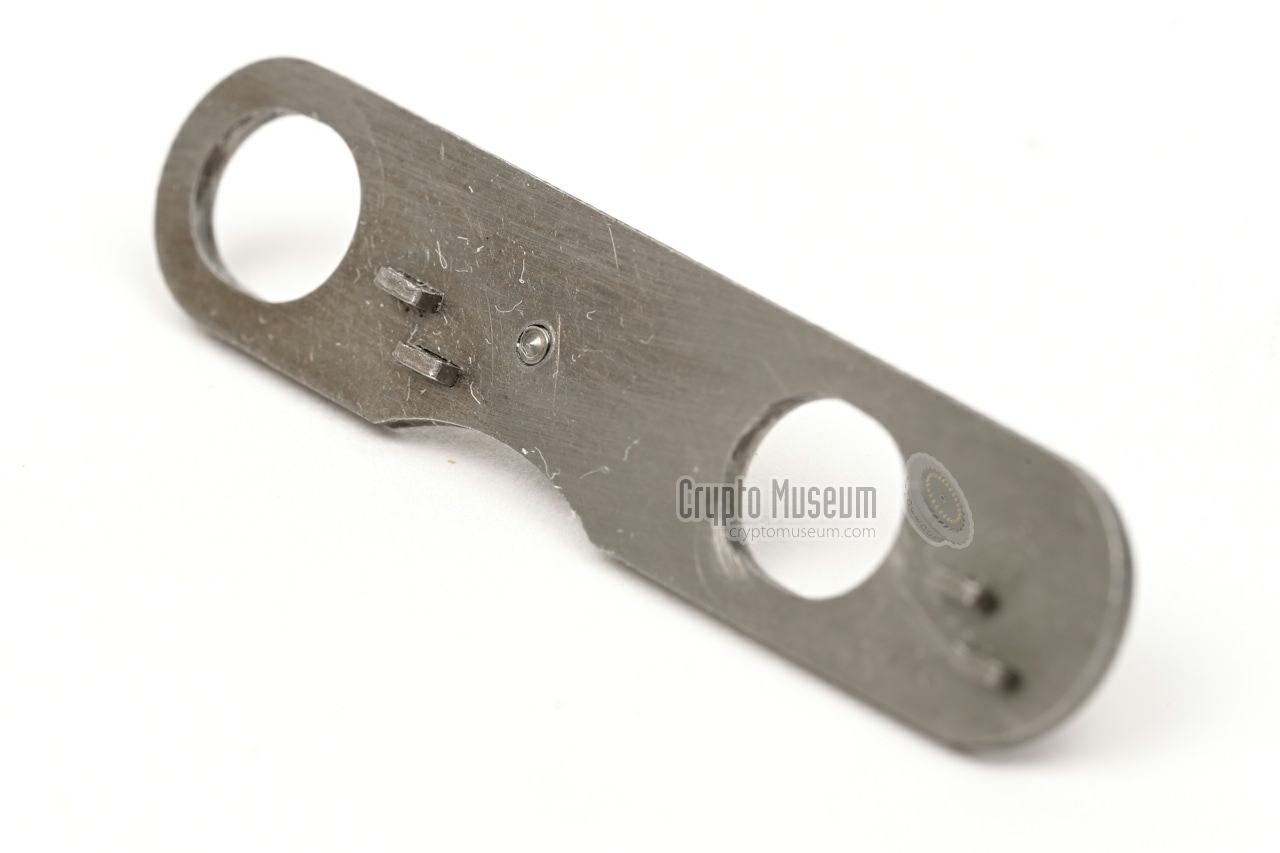
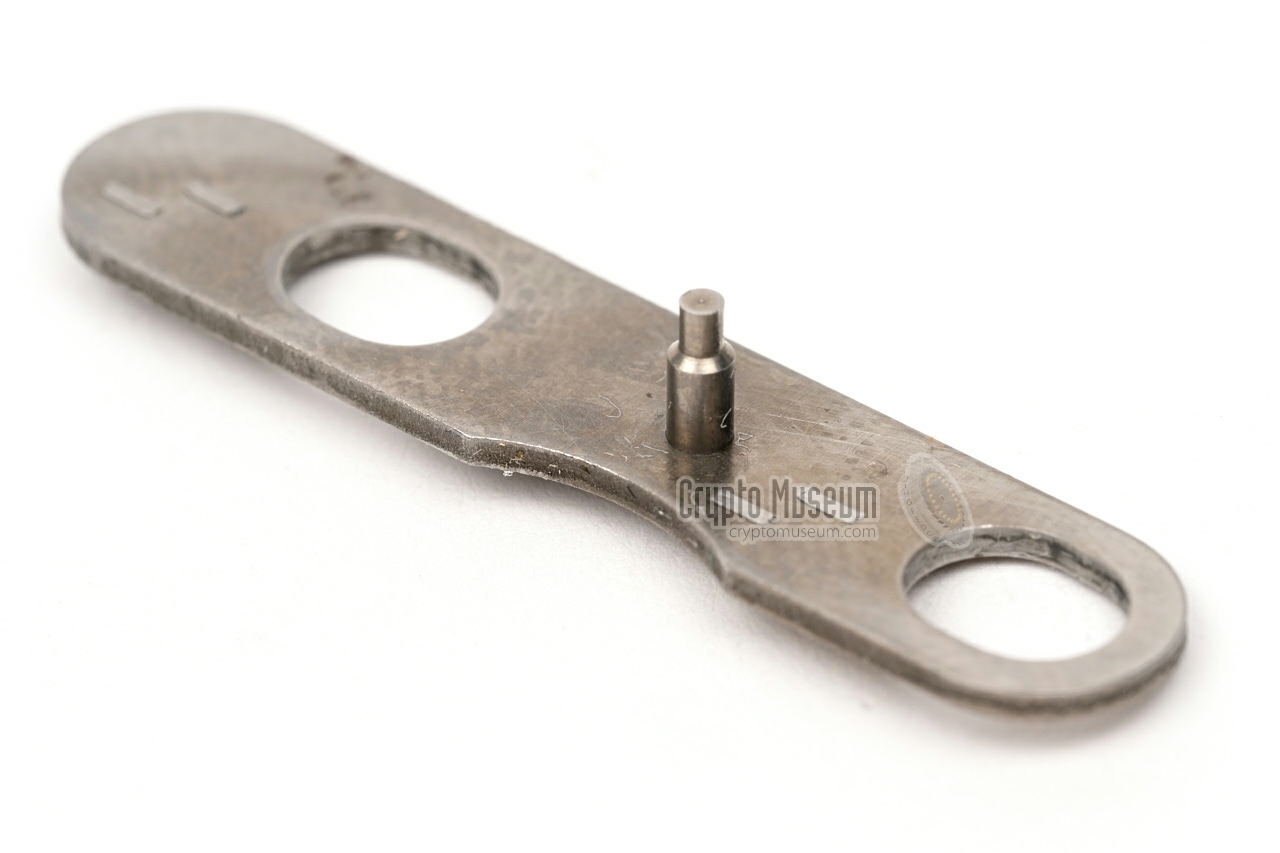
discs, is a horizontal stepping plate with
oval holes, actuated by a pin at its bottom.
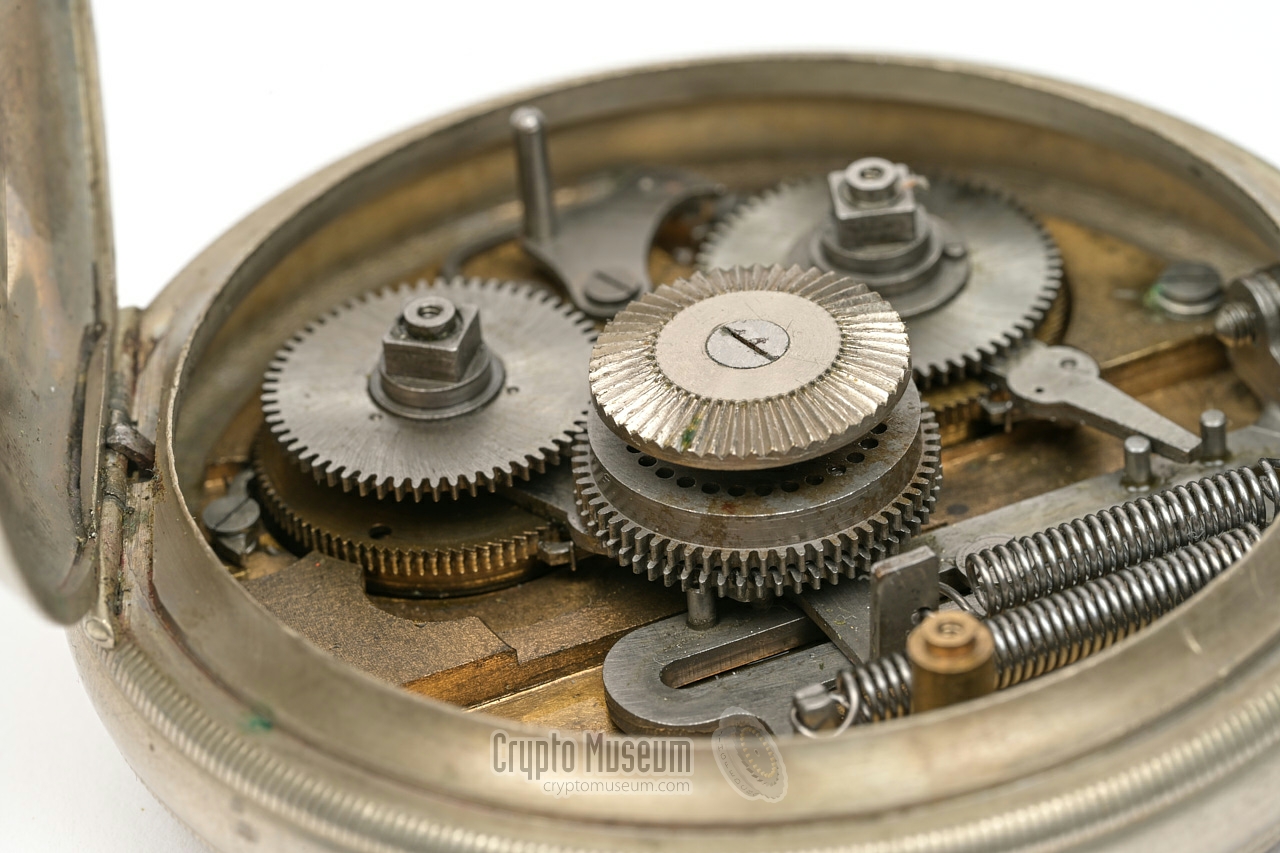
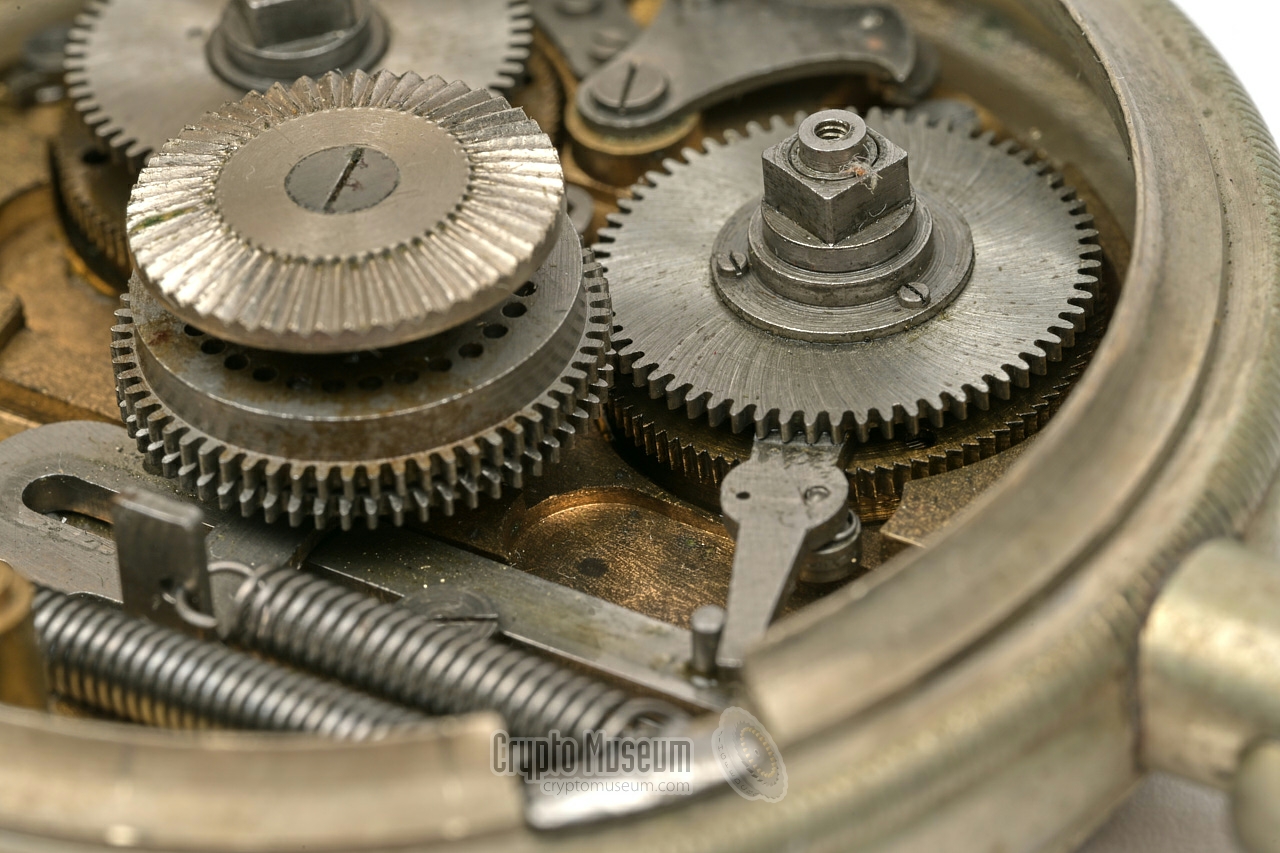
The image on the right shows the mechanism after the two numbered
discs and the stepping plate were removed. The leftmost stack is
responsible for the stepping of the inner letter disc.
The rightmost stack is similar and is
responsible for the stepping of the outer letter disc.
|
|
|
|
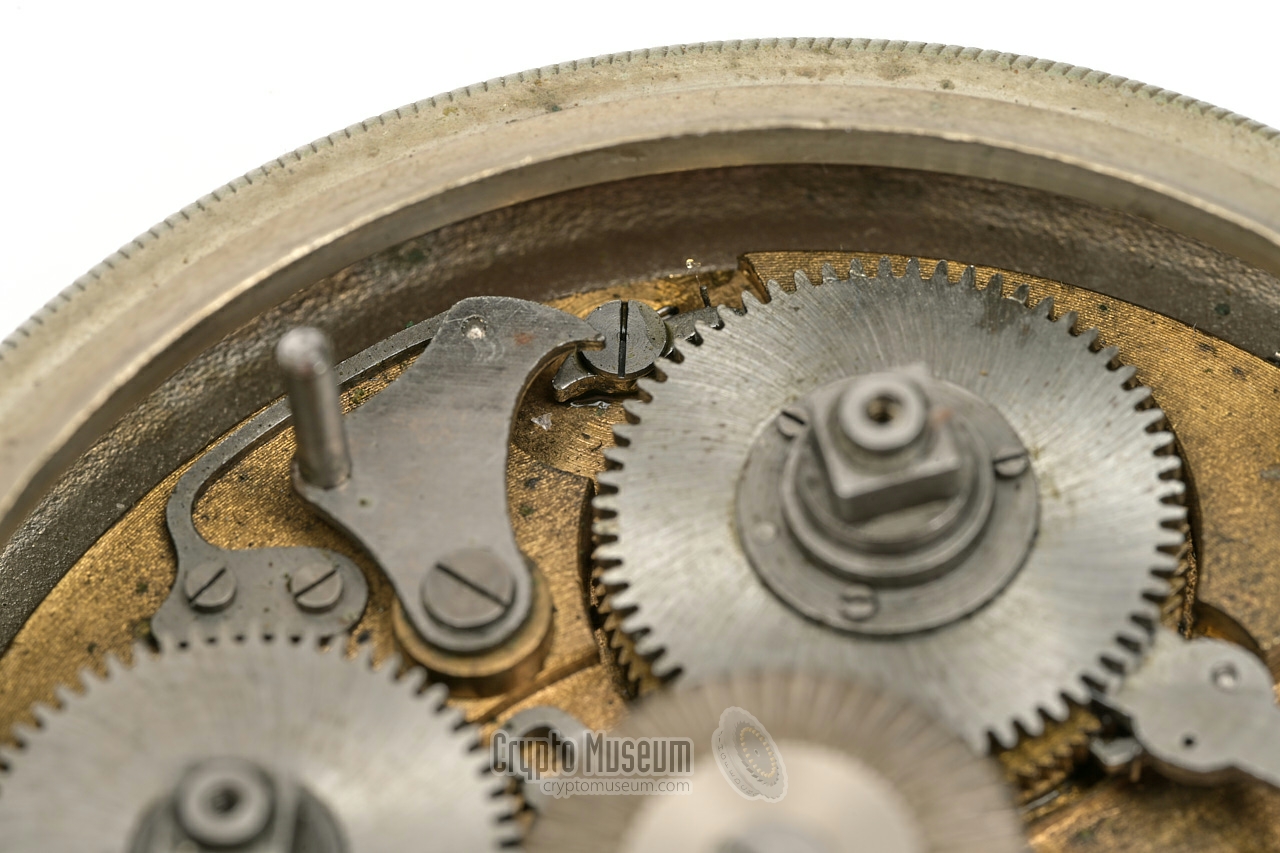
Both stacks consist of a brass ratchet and a steel cogwheel. The ratchets ensure
that the letter discs can only step clockwise. The right stack contains
a slip clutch that allows it to be held in a fixed position when setting
the key. The stepping plate,
which is placed over the two cogwheel
stacks, has two sets of vertical stubs; one for either stack.
The stubs interact with a set of pins at the bottom of the numbered discs,
and control the stepping behaviour of the letter rings at the front.
In the original manual (and patents), the numbered discs are
described as cam-wheels.
|
|
When we obtained the Beyer Krypto device featured here, the glass
at the front was missing and the mechanism was dirty, dry and binding.
Furthermore, the outer letter ring (a piece of
paper glued to the disc) had become detached. it was glued back in
place with a non-invasive glue.
|
In order to clean and oil the mechanism, the back panel had to be
removed, which appeared to be a challenge in its own right. None of the
precision screwdrivers in our workshop fitted the narrow slits of the
small screws. It was therefore decided to modify an existing screwdriver.
With the modified screwdriver it was possible to remove the three screws
from the rear panel, after which the panel could be taken off. This had
to be one very carefully, as the rear panel also holds the
two cam-sheels
onto their square shafts. The two cam-sheels were removed.
|
|
|
The device is operated by a plunger, which is actuated by pressing
the crown inwards. As the plunger was very rusty, it couldn't be operated
smoothly. It was removed by
unscrewing it from the mechanism. This is done
by turning it counter-clockwise until it comes out. The rust was
removed from the plunger and the shaft was cleaned and oiled. The
plunger was then mounted back in place. It now runs smoothly again.
The device was then reassembled, after which it was fully tested.
It now runs smoothly and the letter discs are no longer binding or
hesitating.
|
|
|
|
With the device now being fully operational again, it was time to find
a replacement glass to cover the letter discs. Finding a suitable glass
appeared to be yet another challenge however. It should have a diameter of
51.2 mm and be curved slightly (double concave), with a sharply undercut
edge. Replacement glasses found on the internet didn't fit or had an
unusable outer rim. We then sought the help of a professional watchmaker,
who had a suitable glass and was able to fit it into place in minutes [9].
The result is visible in the image above. We decided not to polish the
exterior of the device, but to leave the patina (and the dent in the
rear lid) as a witness of time.
|
- Dull exterior
Glass missing Mechanism dry and barely operational Outer index ring loose (paper) Rusty plunger - Rear lid dented
|
- Interior cleaned and oiled
- Alphabet on outer ring fixated
- Rust removed from plunger
- Glass replaced
|
Device Mechanical pocket cipher machine Purpose Replacement of codebooks Model KRYPTO Name KRYPTO System Beyer Inventor Peter Georg Grove Beyer (1881-1961) Manufacturer Danish Cipher Machine Co. Ltd. Year 1932-1933 Characters 26 or 30 (depending on model) Key space 7,463,074 (7034 × 1061 combinations) Material Nickel-plated metal Dimensions 90 × 62 × 21 mm Weight 170 g Quantity ?
|
- Klaus Schmeh, The encryption machines of Peter Beyer
Cipherbrain blog, 11 February 2022.
- Ralf Bülow, Wie zwei Dänen beinahe die Enigma erfanden
How two Danes nearly invented the Enigma (German).
HNF-Blog, 1 Febrary 2022.
- Various contributors, Danish Beyer "Krypto" and "Krypto Magnum"
Jerry Proc's crypto pages, 14 October 2018.
- NCF, Code & Cipher Items - Beyer pocket cryptologic device
National Cryptologic Foundation (USA).
- A Revolutionary Code System. A Danish Invention Making Code Books Unnecessary.
Denmark Abroad, Vol. XXVII (27), August 1933. pp. 148-149.
- Niels Faurholt, Beyer operating instructions, articles and photograph
Personal correspondence, January 2025.
- Bonhams, A Rare System Beyer Krypto Pocket Watch Cipher
London, Knightsbridge, 28 September 2022.
- Wikipedia, Kerckhoffs's principle
Retrieved 5 August 2023.
- Nieuwendaal Uurwerkspecialisten, replacement glass for Beyer Krypto device
Peeldijk 43, Budel Dorplein (Netherlands).T: +31 495 492 892.
- Wikipedia, Coprime integers
Accessed 16 April 2026.
|
- Niels Faurholt
- Paul Reuvers
- Marc Simons
|
|
|
|
Any links shown in red are currently unavailable.
If you like the information on this website, why not make a donation?
© Crypto Museum. Created: Saturday 30 November 2024. Last changed: Wednesday, 26 August 2026 - 06:02 CET.
|
|

|
|








![26-step version of the Beyer Krypto with Latin alphabet (A-Z). Photograph via Jerry Proc's crypto pages [3].](img/beyer_26_jproc_thumb.jpg "image # beyer_26_jproc.jpg")

![30-step version of the Beyer Krypto with 'alternative' alphabet. Photograph copyright Bonhams [7].](img/20220928_bonhams_thumb.jpg "image # 20220928_bonhams.jpg")
![26-step version of the Beyer Krypto with Latin alphabet (A-Z). Photograph via Jerry Proc's crypto pages [3].](img/beyer_26_jproc.jpg)
![30-step version of the Beyer Krypto with 'alternative' alphabet. Photograph copyright Bonhams [7].](img/20220928_bonhams.jpg)
![Beyer Magnus Krypto. Photograph kindly provided by Niels Faurholt [6].](img/304268/010/full.jpg)