|
|
|
|
|

|
|
|
First opening day: Sunday 1 November 2026
|
|
|
Following the success of earlier editions of Secret Communications,
the last of which was in 2023, Crypto Museum and the
Foundation for German Communications (CDV&T)
have teamed up again. We are
very pleased to announce our new exhibition: Secret Communications 5,
to be held in Duivendrecht (near Amsterdam, Netherlands).
For us, this is a very special occasion, as it is
the first opening of the CDV&T museum
since the passing of our host Arthur Bauer
last year.
Secret Communications 5 will be open to everyone on the following days:
|
|
On these days, we will be open from 10:00 to 17:00 and admission is free.
Furthermore, coffee, tea and sandwiches will be available free of charge.
We will be showing an exciting collection of
cipher machines and
espionage gear,
some of which has never been on public display before.
Check out what we have selected for you, or click any of
the buttons below to find out more.
|
Free admission Free parking Groups What to expect Directions House rules
|
The exhibition will cover the following main themes:
|
- Enigma & Friends
As usual, we have an exciting line-up of
Enigma cipher machines and accessories, including the famous
machine that was used during WWII, and also the model that was used in the U-boats.
This year we have no less than 8 different models to show you.
The oldest one is 100 years old.
There will also be a fully restored Enigma G that was
formerly used by the Dutch Navy, and a post-war model that has
never been shown to the public before.
Also in this part of the exhibition are various other rotor machines, such as the
NeMa,
Hagelin's B-21, and the last rotor machine ever:
the Hagelin HX-63.
- Monitoring stations
Have you ever wondered how the intelligence services monitored the radio bands
and how they intercepted the communications of military and diplomatic missions?
In this part of the exhibition we show how this was done, with communication gear
that was used as late as the Yugoslav Wars.
- Project EASYCHAIR - The Thing
In an earlier exhibition in 2019, we showed a wide range of
covert listening devices (bugs), some of which did not require
batteries. These are the so-called passive bugs or passive elements. They were
developed by a Dutch company for the American CIA.
The project had the codename EASYCHAIR.
In this exhibition we concentrate on these
passive devices and will demonstrate some of them live to the public for the first time.
- Hardware Security Modules (HSM)
This is the smallest part of the exhibition. Not because the subject is unimportant,
but because the devices are so small. Hardware Security Modules (HSMs) are used
in a variety of applications, to keep communications absolutely secret.
We will show, for example, the equipment that is used by our government to process
your passport data.
- Random Number Generators
The creation of true random numbers is one of the most important aspects
in cryptographic applications. For financial transaction, for example,
it is important that truly random keys are generated, that cannot be predicted
by a malicious party. Random numbers were also used for the creation of
the so-called noise tapes that were used with
one-time tape cipher machines
that were used from the 1940s until at least the 1980s.
- Spy radios
Ten years ago was the last time we showed some of the nicest pieces of our
collection of spy radio sets,
most of which were used during World War II and
the Cold War.
Since then, the collection has grown considerably, and we would very much like
to share this with you. We will show some famous, but also some extremely rare
spy radio sets, many of them for the first time.
|
Last updated 26 September 2026
Below is an overview of some of the items we will be showing and
demonstrating in this exhibition. Further information on each item is available
by clicking the corresponding thumbnail image below.
This list will be updated regularly so please visit this page again soon.
|
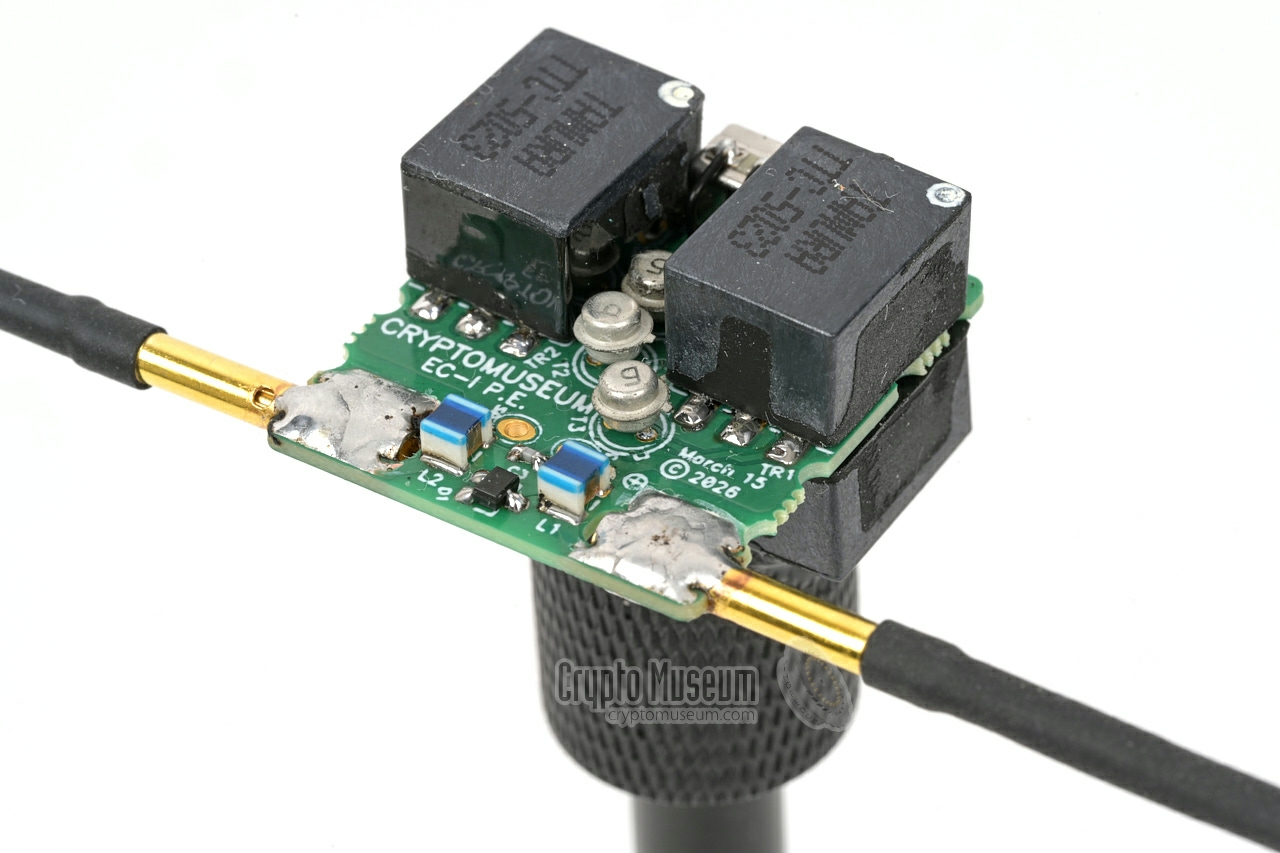
There are various ways to create the true random numbers that are required
for the use of One-Time Pads (OTP) and
One-Time Tapes (OTT).
Especially for Secret Communications 5, Karsten Hansky created this OTP
generator with built-in printer, which is based on radioactive decay.
It allows you to print your own unique OTP pair, and take it home with you
after your visit.
|
|
|
Admission is completely free.
There is no need to make reservations.
Sandwiches and drinks are also free.
We do not charge an entrance fee, but visitors are welcome to make
a voluntary donation, at their own discretion. No obligations.
|
Smaller groups are welcome to visit the exhibition during normal
opening hours.
There is no need to make reservations.
Large groups may apply for a closed visit outside the regular opening
days and times. Note however, that we have a limited number of days
available for this.
➤ Contact Crypto Museum to make arrangements.
|
The exhibition is located at the premises of the
Foundation for German Technology
— the private museum of the late Dutch collector
Arthur Bauer and his wife Karin — which is located in
Duivendrecht, near Amsterdam (Netherlands). Click the map above
for Google directions.
The address is:
Kloosterstraat 21
1115 BJ Duivendrecht
Netherlands
|
Important —
Please note that the houses in this street have recently been renumbered.
Google Maps is not yet aware of these changes. When using Google Maps,
please search for the old address: Kloosterstraat 25 or click the button below.
Find on Google maps
- Visitors are required to register upon arrival.
- You are allowed to take photographs.
- You may be photographed by others and these photographs may be published.
- For your and our safety there will be CCTV cameras in operation.
- The recorded images will only be used in case of an incident and will
otherwise be deleted after the event. - Please do not touch any of the exhibits unless specifically permitted by our staff.
- All high-value items will be removed from the exhibition at the end of each day.
|
|
|
Free parking at the other side of the A10 - 5 minute walk
|
|
|
We have arranged for free parking places on Saturday and Sunday at the parking lot of
Bakkerij Amstelveld, H.J.E. Wenckebachweg 167 in Amsterdam, just at the other side
of the A10 ring road. Opposite the entrance of the parking – slightly to the
left – is a footpath under the A10 which brings you almost straight to the
Kloosterstraat in Duivendrecht.
Follow the footpath and turn left at the end.
At the next junction turn left again. On this road take the footpath at the left.
On the map below, the route to the exhibition is marked in red.
It's a 5 minute walk.
Please use your sat nav or Google Maps
to navigate to Wenckebachweg 167 in Amsterdam.
➤ PDF with the above map
|
|
|
Parking in the immediate vicinity - 2 hours max
|
|
|
Please note that the museum is located in a residential area and that limited
parking space is available in the immediate vicinity.
Furthermore, the area in which the museum is located is a so-called blue zone,
which means that parking is free of charge, but is restricted to just 2 hours.
In addition, the the time of arrival has to be shown by means of a
blue parking disc (shown on the right) behind the windscreen of your car.
This means that you will have to update your disc regularly.
If you don't have a blue parking disc, you can get one on loan at the entry desk.
|
|
|
|
Additional parking space is available at the shopping mall – at walking distance,
just 200 m south of the museum –
but this is also a blue zone and is therefore free of charge, but restricted
to two hours. If you choose this option, please do not forget to update your blue
parking disc regularly.
|
|
|
Duivendrecht train station - 7 minutes on the bus
|
|
|
Payed parking spaces with unlimited duration are available at the Duivendrecht
train station (Stationsplein, 1115 BZ Duivendrecht). From there, take bus line 41
which leaves every 15 minutes and takes you here in just 7 minutes.
Take the exit at Burg. van Damstraat.
|
- Parking map
Route from the free parking zone to the museum.
|
|
|
|
Any links shown in red are currently unavailable.
If you like the information on this website, why not make a donation?
© Crypto Museum. Created: Monday 24 August 2026. Last changed: Thursday, 22 October 2026 - 17:58 CET.
|
 |

|
|
|
|